water meter-Shandong Chenshuo
HOMENEWS

NEWS

Electromagnetic Water Meter & Flowmeter Guide for Industrial and Municipal Applications

212026/08

Electromagnetic Water Meter & Flowmeter Guide for Industrial and Municipal Applications

An Electromagnetic Water Meter & Flowmeter measures conductive-liquid velocity through electromagnetic induction. Municipal projects commonly use these instruments for water accounting and network monitoring, while industrial projects use them for process measurement and control. Selection depends on the liquid, flow range, materials, power, communications, and installation conditions.

How Does an Electromagnetic Water Meter & Flowmeter Work?

Industrial electromagnetic flow meter on stainless steel process pipeline.webp   Both instruments apply the same physical principle. A measuring tube, magnetic field, electrodes, and converter turn liquid movement into flow data.

Faraday's Law, Electrodes, and the Converter

Coils generate a magnetic field across the measuring tube. Conductive liquid moving through that field creates an induced voltage at two electrodes. The converter processes this velocity signal into volumetric flow, display values, outputs, and digital data according to the configured model. The open measuring tube produces little hydraulic restriction; its lining and electrodes must suit the liquid chemistry.

Conductive Liquids, Full-Pipe Conditions, and Measurement Limits

The liquid must fill the tube and meet the meter's conductivity limit. Chenshuo series material specifies above 5 microSiemens/cm. Water, wastewater, conductive chemicals, mud, ore slurry, and pulp can qualify with compatible lining and electrodes. Gas, steam, petroleum products, organic solvents, and very-low-conductivity liquids require another principle. Submit composition, concentration, temperature, solids, conductivity, and expected air content for selection.

What Is the Difference Between an Electromagnetic Water Meter and Flowmeter?

The product names describe application and operating priorities. An electromagnetic water meter supports water-volume accounting and distribution management. An industrial electromagnetic flowmeter supports continuous process measurement and control for a broader range of conductive liquids.
Decision Field Electromagnetic Water Meter Electromagnetic Flowmeter
Primary role Water consumption, district metering, network monitoring Process flow measurement, control, and totalization
Typical media Raw water, treated water, distribution water Water, wastewater, conductive chemicals, slurries, pulp
Operating focus Low-power operation, accumulated volume, remote reading Material compatibility, process signals, response, control integration
Common power Internal battery or project-defined supply Mains or DC supply; remote or integrated converter options
Buyer must define DN, Q1-Q4 or flow range, pressure, temperature, communications Medium, conductivity, flow range, lining, electrodes, outputs, environment

When an Electromagnetic Water Meter Fits

This category serves water accounting, district metering, distribution monitoring, and remote utility data. Chenshuo's DN40 and DN50 configuration specifies R400, Class 2, T50, 1.6 MPa, 3.6 V lithium power, and RS485. Listed Q3 values are 25 m3/h for DN40 and 40 m3/h for DN50. Confirm the quoted model and destination documents when reviewing
electromagnetic water meter options.

When an Industrial Electromagnetic Flowmeter Fits

Industrial flowmeters provide selected liners, electrodes, control outputs, and converter arrangements. Chenshuo series material covers DN3-DN3000, integrated or remote configurations, and optional Modbus-RS485, HART, GPRS, or PROFIBUS. The quotation should identify the exact sensor, converter, power, output, and protocol. Electromagnetic water meter installed on pipeline at municipal water treatment plant

Where Are Electromagnetic Meters Used?

Application fit begins with the liquid and operating objective. The following matrix connects common municipal and industrial duties with the first specifications to define.
Application Measurement Objective Key Inputs
Municipal trunk main or district Total volume, network balance, remote monitoring DN, minimum and peak flow, pressure, power, data interval
Water or wastewater treatment Process flow, dosing balance, discharge records Conductivity, solids, chemicals, lining, electrodes, outputs
Industrial cooling or circulating water Process monitoring and control Temperature, flow range, pressure, control signal, communications
Chemical, slurry, or pulp line Conductive-medium flow under material exposure Composition, concentration, solids, abrasion, lining, electrodes
Irrigation and water-resource network Distribution volume and operating status Pipe size, hydraulic range, power, enclosure, remote data

Municipal Water Supply, District Metering, and Irrigation

Municipal projects use meters at treatment outlets, trunk mains, district boundaries, distribution branches, and irrigation networks. Define minimum, normal, and peak flow; pressure; power; chamber conditions; data collection; and local metrology requirements. Reporting intervals and communications affect a battery-powered meter's energy budget.

Wastewater Treatment and Industrial Effluent

Wastewater and effluent may contain solids, chemicals, or changing conductivity. Match these conditions to the liner and electrodes, then locate the sensor in a full pipe away from trapped air. Review industrial electromagnetic flowmeters by diameter, converter arrangement, and signal requirements.

Process Water, Cooling Systems, Chemicals, Slurries, and Pulp

Industrial duties include process water, cooling water, conductive acids and alkalis, mud, ore slurry, and pulp. Submit composition, concentration, temperature, solids, and abrasion so the supplier can select lining and electrodes.

How Do You Select the Right Meter and Configuration?

A controlled data sheet creates one basis for model selection and quotation comparison.

Pipe Size, Flow Range, Pressure, and Temperature

Provide DN, flange rating, minimum, normal, and maximum flow, pressure, and temperature. Select diameter from the usable flow range. Oversizing can place normal flow near the lower limit; undersizing raises velocity. Chenshuo series conditions list sensor ambient temperature from -25 to 60 degrees C, converter ambient temperature from -10 to 60 degrees C, and a 70 degrees C integrated-configuration fluid limit. Confirm the quoted model and liner.

Lining, Electrode, Conductivity, and Material Compatibility

The liner provides electrical isolation and chemical protection; electrodes contact the liquid. Submit conductivity, composition, concentration, temperature, solids, and abrasion. The supplier should state materials, compatibility basis, and operating limits.

Power, Outputs, Communications, and Data Integration

Define power, battery expectations, display, instantaneous and total flow, 4-20 mA, pulse or frequency output, alarms, and required digital interface. Identify the receiving PLC, SCADA, telemetry unit, or meter-reading platform. Include the protocol, register map, wiring, baud rate, data format, and commissioning owner.

What Installation and Maintenance Conditions Matter?

Installation geometry and electrical reference shape the quality of the measured signal. Use the manual for the quoted sensor and converter.

Full Pipe, Grounding, Air, Sediment, and Straight Runs

Install the sensor in a full pipe. A rising vertical section can move air and reduce sediment. Position electrodes away from trapped bubbles or settled solids, ground the liquid correctly, and separate signal wiring from electrical interference. Straight-run requirements vary by model and disturbance. Chenshuo material includes a 5D upstream and 3D downstream example; use the quoted model's manual around elbows, pumps, valves, and reducers.

Integrated vs. Remote Converter Arrangement

An integrated converter mounts electronics on the sensor. A remote converter uses a signal cable for protected or accessible placement. Choose from flooding, vibration, temperature, readability, access, cable length, and enclosure requirements.

Commissioning Checks and Routine Diagnostics

Commissioning should verify pipe fullness, grounding, direction, zero behavior, flow, totalization, outputs, communications, and alarms. Record the configuration and results. Maintenance can cover electrodes, grounding, empty-pipe diagnostics, cables, and data trends under project and water meter manufacturing and quality control requirements.

What Should an RFQ Include?

An Electromagnetic Water Meter & Flowmeter RFQ should identify the application, liquid, conductivity, solids, DN, flow range, pressure, temperature, materials, installation, converter, power, outputs, communications, enclosure, quantity, destination, and delivery term. Request model drawings, test records, protocol documents, and destination approvals so suppliers quote one technical scope.

About Chenshuo

Shandong Chenshuo Instrument Co., Ltd. develops and manufactures water-meter and flow-measurement products. Its official categories list the LXE-100 electromagnetic water meter and DN15, DN50, DN100, and DN300 electromagnetic flowmeters. To request an electromagnetic meter quotation, submit the medium, conductivity, DN, flow range, pressure, temperature, materials, power, signals, communication, installation, destination, quantity, and documents. Chenshuo can use these inputs to define a configuration and quotation scope.

FAQ

Q1: What Is the Difference Between an Electromagnetic Water Meter and an Electromagnetic Flowmeter? A: Both use electromagnetic induction for conductive-liquid flow. A water meter supports volume accounting and utility networks; an industrial flowmeter provides process-oriented material, signal, power, and converter choices. Q2: Which Liquids Can an Electromagnetic Water Meter or Flowmeter Measure? A: It measures liquids that meet the configured conductivity limit. Water, wastewater, conductive chemicals, and some slurries can qualify. Gas, steam, oil, organic solvents, and very-low-conductivity liquids require another principle. Q3: Does an Electromagnetic Flowmeter Require a Full Pipe? A: Yes, standard full-bore electromagnetic flowmeters require the measuring tube to remain full. Air pockets or an empty tube can interrupt the electrode signal and create unstable or zero readings. Q4: How Do You Size an Electromagnetic Water Meter or Flowmeter? A: Size it from minimum, normal, and maximum flow together with DN, velocity, pressure, and hydraulic conditions. Keep normal operation inside the quoted model's usable range. Q5: What Information Should You Send for an Electromagnetic Meter Quotation? A: Send the liquid, conductivity, composition, temperature, pressure, solids, DN, flow range, liner and electrode needs, power, outputs, communication, installation, quantity, destination, approvals, and delivery term. The supplier can then define one traceable configuration.

MORE
Outdoor smart water meter with antenna in municipal water network.webp

212026/08

Smart Water Meter Cost: What Affects the Final Price?

Smart Water Meter cost depends on the meter body, measuring technology, pipe size, communication module, control functions, project services, and delivery terms. Give each supplier the same technical and commercial inputs to compare quotations on one basis.

What Does Smart Water Meter Cost Include?

Smart Water Meter Cost What Affects the Final Price A supplier may quote a meter-only factory price, a configured device price, or a project package. State the required basis in your request for quotation (RFQ). The budget may include hardware, software, gateways, testing, installation, freight, import charges, commissioning, and support.
Cost Layer Typical Items Buyer Input Supplier Confirmation
Meter Body, measuring module, display, battery, enclosure Size, flow range, pressure, temperature, installation Model, materials, accuracy scope, included accessories
Smart functions Communication, valve, STS prepayment, alarms Network, reporting interval, billing method, control rules Enabled functions, firmware, protocol, data format
Project work Samples, customization, testing, documentation Destination market, acceptance plan, branding Deliverables, test scope, approvals, engineering charges
Landed delivery Packing, freight, insurance, duties, local work Quantity, destination, delivery term, schedule Incoterm, shipment method, exclusions, delivery basis
Lifecycle Platform, SIM or network fees, spares, batteries, support Service period, device count, maintenance plan Recurring fees, warranty, spare parts, response scope

Meter Hardware and Factory Options

Compare
smart water meter options by diameter, connection, materials, metrology class, flow range, temperature class, pressure rating, display, battery, and ingress protection. List couplings, antennas, check valves, keypads, and fittings.

Project Engineering and System Components

Define who supplies gateways, SIMs, the network server, payload decoder, API documents, platform, user accounts, and commissioning. Assign each component to the supplier, integrator, contractor, or buyer.

Freight, Import Charges, and Local Installation

Quantity, packaging, shipment method, destination, insurance, Incoterm, duties, taxes, and local handling determine landed cost. Installation may add fittings, labor, signal testing, registration, and acceptance records.

Which Meter Specifications Affect the Price?

Quotation accuracy begins with a controlled specification sheet. One change in measuring principle, diameter, radio, valve, or certification scope can create a different product and test requirement.

Mechanical Pulse vs. Ultrasonic Metering

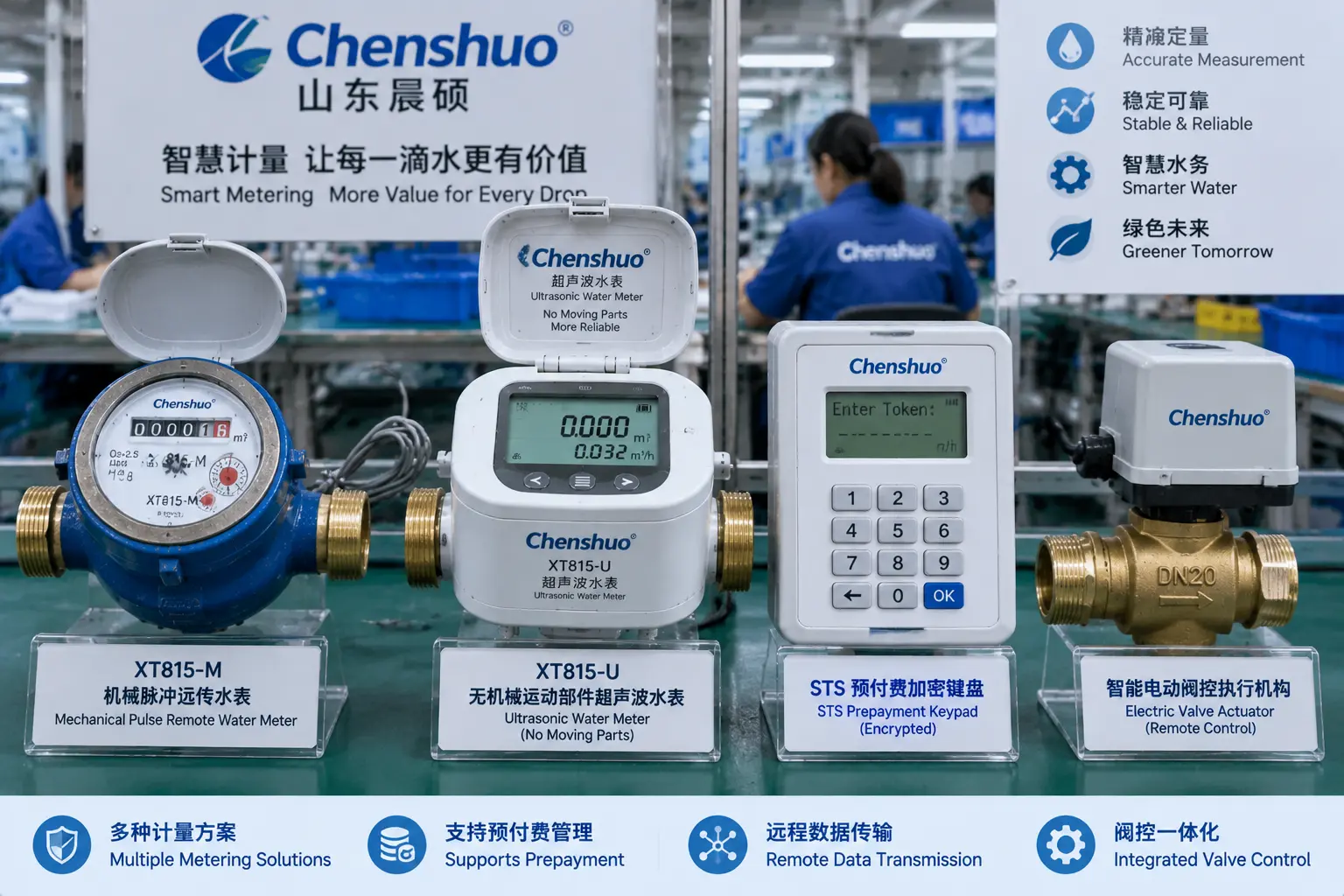
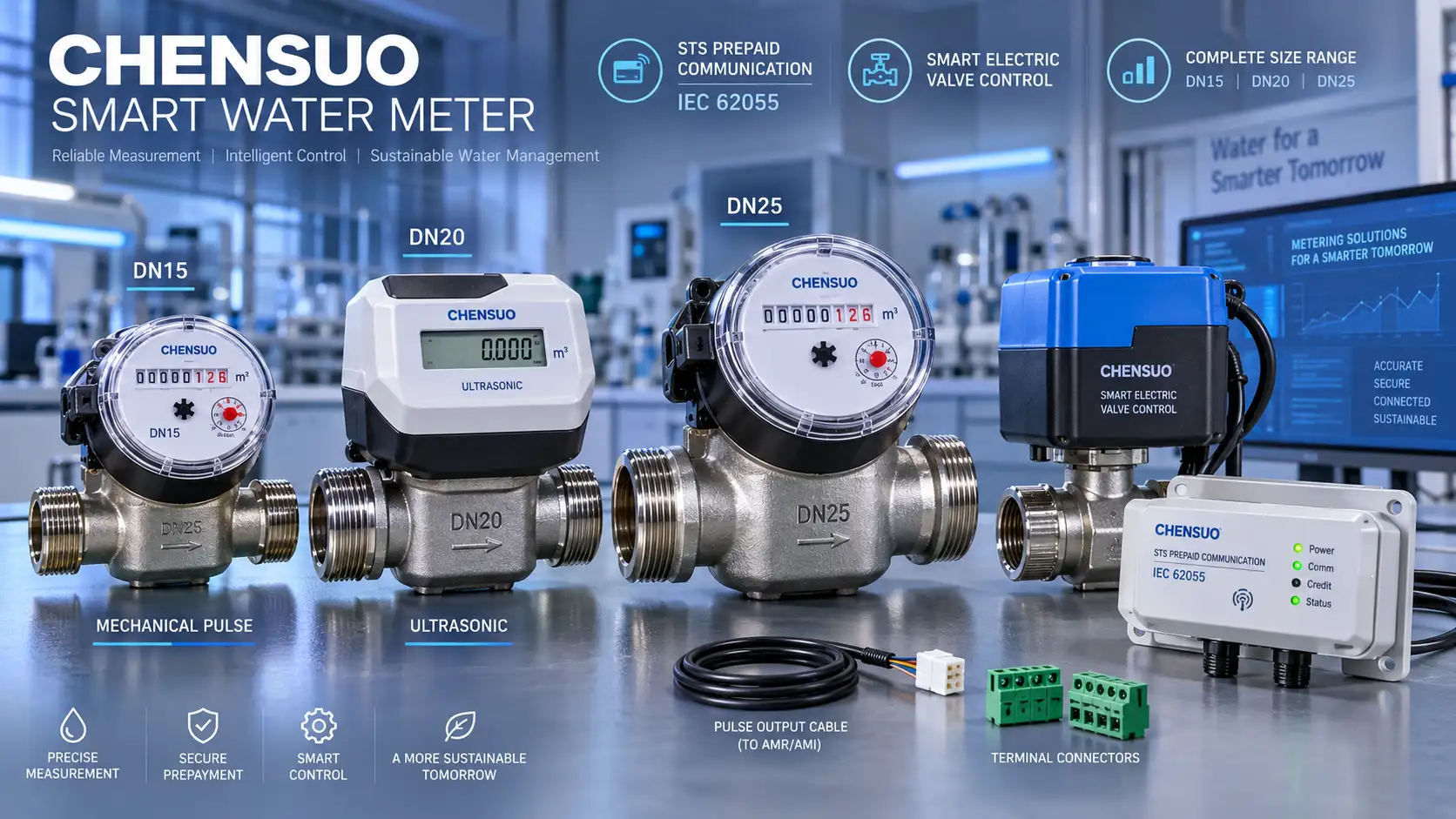
Chenshuo's XT815 series illustrates two configurations. XT815-M uses a mechanical impeller with pulse detection and has an R100 turndown ratio. XT815-U uses ultrasonic transit-time measurement, has an R250 ratio, and provides micro-flow leakage and empty-pipe detection. XT815-M provides magnetic-interference detection. Select the principle from the required flow profile, installation conditions, water quality, and monitoring functions.

Diameter, Flow Range, Materials, and Accuracy

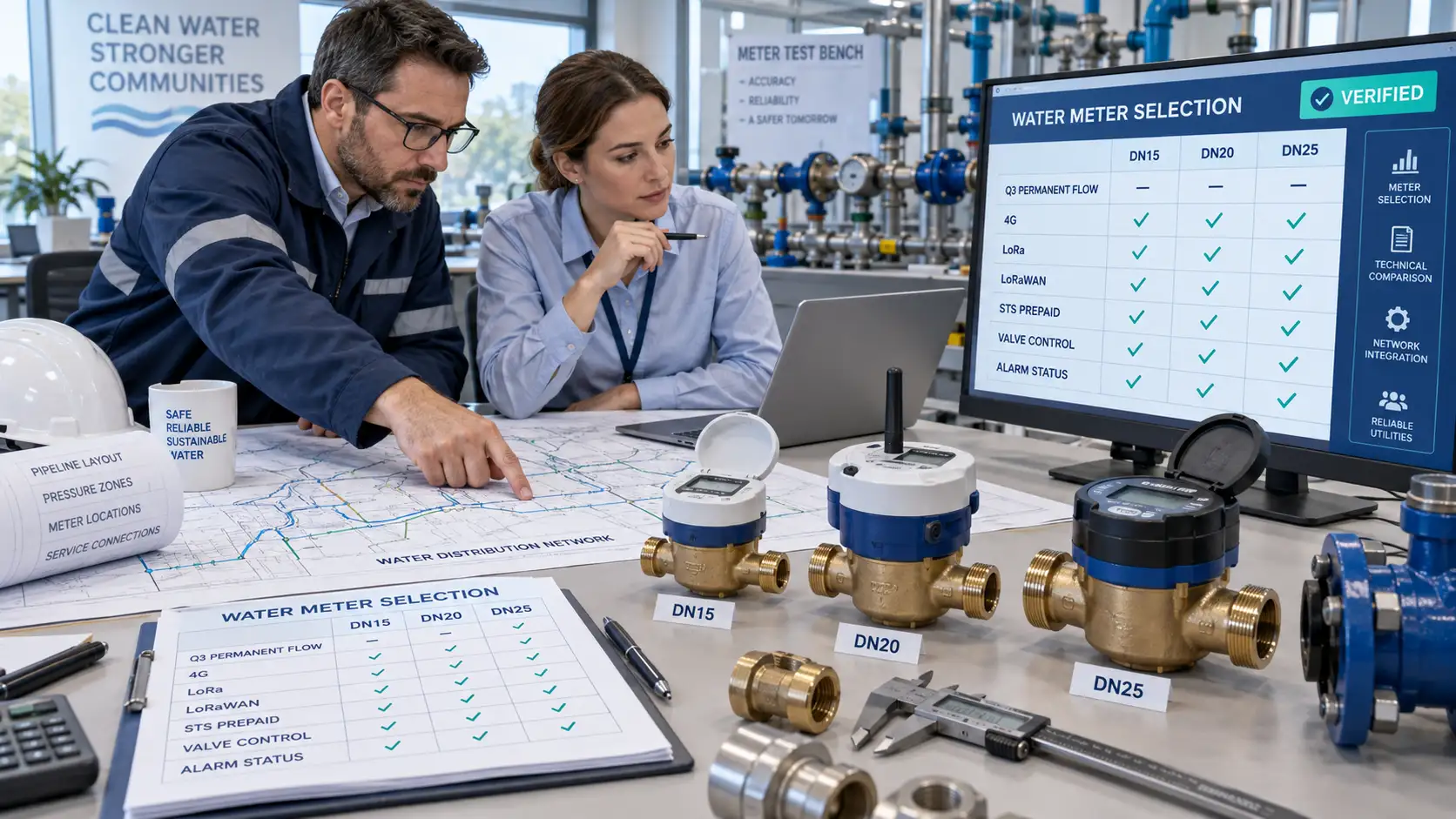
The documented XT815-M and XT815-U sizes include DN15, DN20, and DN25. Their permanent flow rates, Q3, are 2.5, 4.0, and 6.3 m3/h respectively. Both models are listed as Class 2, T30, and 1.6 MPa. Put the diameter, Q3, connection, body material, installation direction, and applicable metrology documents in the RFQ.

IP Rating, Battery, Display, and Installation Conditions

The XT815 series lists IP68 protection and a lithium-battery service estimate of 6-10 years under its specified operating profile. Battery demand changes with reporting frequency, retries, valve operations, alarms, temperature, and signal quality. Installation requirements also affect labor: the ultrasonic model needs a full pipe, air management, and the specified straight-pipe sections.

How Do Communication and Control Functions Change the Quote?

A radio name defines only part of the supplied system. The quotation should identify the module, regional settings, antenna, device credentials, message format, reporting schedule, network ownership, and platform interface.

4G, LoRa, LoRaWAN, and Network Requirements

The XT815 documentation lists 4G, LoRa, and LoRaWAN options. Each option creates its own network and integration scope. For a global order, confirm destination-country frequencies, operator or gateway compatibility, activation, security keys, payload decoding, API fields, and local radio approval for the quoted model.

STS Prepayment, Valve Control, and Alarm Functions

The STS prepaid smart water meter supports an IEC 62055 STS workflow with 20-digit tokens and a motorized ball valve. The documented functions include low-balance warning, closure for depleted credit, reopening after top-up, remote valve commands, valve-status feedback, and fault reporting. State which functions the factory must enable and test.

Gateways, Platforms, APIs, SIMs, and Data Services

Recurring charges can sit outside the device line. Ask for separate prices for gateways, SIMs, network subscriptions, cloud hosting, dashboards, API access, firmware service, storage, training, and technical support. Define the billing period and device count for every recurring item.

Which Project Costs Sit Outside the Meter Unit Price?

Outdoor smart water meter with antenna in municipal water network Global projects may involve laboratories, carriers, customs brokers, installers, network operators, and system integrators.

Samples, Customization, Testing, and Documentation

List samples, private labels, packaging languages, manuals, firmware settings, protocol changes, test reports, certificates, and inspection records. Identify tooling, engineering, laboratory, and approval charges. Use a signed sample for water meter manufacturing and quality control.

Installation, Commissioning, and Network Setup

Site work can include pipe preparation, fittings, mounting, leak checks, radio surveys, gateways, device enrollment, platform mapping, and training. Define acceptance tests for metrology, data, alarms, valves, and records.

Packaging, Freight, Insurance, Duties, and Taxes

Request weight, carton size, pallet method, commodity code, origin documents, schedule, and delivery term. Use destination-country rules and a carrier quotation.

How Can You Compare Smart Water Meter Quotations?

Send one RFQ sheet to every bidder. Record the model, revision, currency, validity, quantity break, Incoterm, lead time, payment terms, and exclusions.
RFQ Field Required Detail Quoted Basis Open Item
Meter configuration Model, DN, Q3, principle, materials, pressure, temperature Unit price by quantity Accessories and spares
Smart scope Radio, frequency, valve, STS, alarms, reporting Enabled device configuration Gateway, SIM, platform, API
Compliance Model-specific metrology and radio documents Included records and tests Local approval or laboratory work
Delivery Quantity, packaging, destination, Incoterm Freight and schedule basis Duties, taxes, local handling
Service Warranty, training, firmware, spares, fault handling Included period and response Recurring and post-warranty fees

Send the Same RFQ Specification to Every Supplier

Use one revision-controlled sheet. Add missing inputs and issue each revision to all bidders.

Separate Included Items, Options, and Recurring Charges

Request three columns: included, optional, and recurring. Finance teams can map each charge to its payment period.

Confirm Delivery Terms, Warranty, Spares, and Support

XT815 terms state a one-year warranty from manufacture for qualifying product faults. Confirm the start date, claim evidence, remedy, exclusions, spares, and technical contact.

How Should You Estimate the Final Smart Water Meter Cost?

Final Smart Water Meter cost equals the specified device, enabled communication and control functions, project engineering, landed delivery, local implementation, and lifecycle commitments. Build the estimate from named line items and destination-specific charges. A complete RFQ gives each bidder the information needed to return a comparable quotation.

About Chenshuo

Shandong Chenshuo Instrument Co., Ltd. supplies smart water meters and project support. The XT815 prepaid series includes mechanical pulse and ultrasonic models with DN15, DN20, and DN25 configurations, 4G, LoRa, or LoRaWAN communication options, STS token processing, valve control, IP68 protection, and model-specific monitoring functions. To request a smart water meter quotation, submit the destination country, application, quantity, diameter, Q3 or flow range, metering principle, communication method, regional network requirements, STS and valve functions, installation environment, required documents, platform scope, packaging, and delivery term. Chenshuo can use these inputs to define the quoted model and supply scope.

FAQ

Q1: How Much Does a Smart Water Meter Cost? A: Smart Water Meter cost depends on its measuring technology, size, materials, communication, control functions, order quantity, project services, and delivery basis. Send a complete RFQ to receive a price for one defined configuration. Q2: Does an Ultrasonic Smart Water Meter Cost More Than a Mechanical Model? A: The price relationship depends on the exact models and supplied functions. For the XT815 series, compare the mechanical R100 configuration with the ultrasonic R250 configuration, then request prices for the same diameter, radio, valve, STS, accessories, and delivery scope. Q3: Which Communication Options Affect Smart Water Meter Cost? A: 4G, LoRa, and LoRaWAN create different module, network, gateway, SIM, and integration requirements. The quotation should list the device hardware and every network, platform, API, or recurring service item. Q4: Is Installation Included in a Smart Water Meter Quote? A: Installation is included only when the quotation names the site work and acceptance tasks. Check pipe preparation, fittings, labor, commissioning, signal testing, device registration, travel, and local taxes. Q5: What Information Is Needed for an Accurate Smart Water Meter Quotation? A: Provide the destination, application, quantity, DN size, Q3 or flow range, pressure, temperature, metering principle, communication, billing method, valve and alarm functions, documents, platform scope, packaging, Incoterm, and schedule. These fields let the supplier define one traceable supply scope.

MORE
How to Choose a LoRaWAN Water Meter Supplier

142026/08

How to Choose a LoRaWAN Water Meter Supplier

Utility technician inspecting a LoRaWAN smart water meter installed in an underground meter pit using a rugged tablet   A reliable LoRaWAN Water Meter supplier should prove six capabilities: correct meter selection, regional radio compatibility, field durability, data integration, documented quality control, and project support. Start with your operating conditions, then request technical files, samples, and a pilot plan.

What Should You Define before Contacting a Supplier?

Pipe conditions, billing rules, communication architecture, and maintenance plans shape the meter configuration. A short project brief makes quotations easier to compare.

Project Environment, Pipe Size, and Flow Range

List pipe sizes, expected flow, water temperature, pressure, installation direction, water quality, and meter location. Soil, concrete, distance, and metal pit covers can weaken radio signals. Match the range ratio to actual consumption. Household low flow and seasonal irrigation demand require different measurement ranges. Review
LoRaWAN Water Meter options by diameter and metering method before requesting samples.

Billing, Prepayment, and Valve Requirements

State whether the project uses postpaid billing, prepaid credit, or both. For STS projects, confirm IEC 62055 compatibility, 20-digit TOKEN handling, key management, recharge records, low-balance warnings, and valve actions. Define who may open or close the valve and how the system records each command.

Network Ownership and Data Platform

State who supplies gateways, the network server, and the data platform. Provide the interface, reporting schedule, device count, alarm rules, and required data fields. Assign responsibility for device registration, keys, firmware, API documents, and commissioning.

Which LoRaWAN Specifications Must You Verify?

A usable LoRaWAN specification names the regional frequency plan, network settings, payload structure, power assumptions, and installation limits.

Regional Frequency and Network Compatibility

Confirm the destination frequency plan and channel configuration. Public information for the LXS-15 to LXS-50 range lists 470-510 MHz and configurable 868-915 MHz options. Request written confirmation for the region, gateway, network server, and local radio rules.

Activation, Security, Payload, and API Integration

Ask for the activation method, LoRaWAN version, device class, encryption process, and key-delivery procedure. Request a payload decoder and sample messages for consumption, battery, valve status, tamper events, leakage, and faults. Test them on your server.

Antenna Placement, Signal Testing, and Reporting Intervals

Radio range changes with terrain, buildings, pit depth, antenna position, and covers. One Chenshuo product page lists a typical 1-6 km distance and ties the result to the test environment. Measure RSSI, SNR, packet delivery, and retries at representative sites. Match reporting intervals to the battery calculation.

Should You Choose a Mechanical or Ultrasonic Water Meter?

Quality control engineer testing mechanical and ultrasonic smart water meters on an industrial laboratory test bench   Metering technology affects sensitivity, installation, maintenance, and cost. The XT815 series provides two practical paths for residential and utility projects. Current commercial documents should confirm the final configuration.
Item XT815-M Mechanical Pulse Type XT815-U Ultrasonic Type
Metering method Mechanical impeller with pulse collection Ultrasonic transit-time measurement
Range ratio R100 R250
Common sizes DN15, DN20, DN25 DN15, DN20, DN25
Q3 by size 2.5, 4.0, 6.3 m³/h 2.5, 4.0, 6.3 m³/h
Dedicated monitoring Magnetic interference detection Microflow, leakage, and empty-pipe detection
Typical fit Residential programs and budget-led retrofits Low-flow measurement and stricter water-loss control
Both models use Class 2 metering, T30 temperature classification, 1.6 MPa rated pressure, IP68 protection, valve control, and 4G, LoRa, or LoRaWAN communication options. The listed lithium battery life is 6-10 years under the specified operating profile.

When a Mechanical Pulse Meter Fits the Project

The mechanical model suits established residential applications, large replacement programs, and projects that value familiar construction. Its magnetic-interference function supports tamper monitoring. Standard installation guidance calls for at least 5DN upstream and 2DN downstream straight pipe, with longer sections near flow disturbances.

When an Ultrasonic Meter Fits the Project

The ultrasonic model uses no moving measuring parts and supports microflow detection. It suits projects focused on low-flow capture, leakage alerts, scale resistance, and water-loss analysis. The pipe must remain full. Recommended installation includes upstream air removal, an outlet check valve, and at least 10DN upstream and 5DN downstream straight pipe under standard conditions.

How Valve Control and STS Change the Choice

For prepaid supply, test low-balance warnings, automatic closing, recharge opening, remote commands, valve-position feedback, and jam alarms. A field test should include poor signal, low battery, interrupted recharge, and repeated valve cycles. These events reveal how the complete system behaves during daily operation.

How Do You Check Product Quality and Compliance?

Quality review combines documents with physical tests. Ask the supplier to connect each claim to a model, batch, test method, and destination market.

Metering Standards, Type Approval, and Calibration Evidence

Request the applicable metrology certificate, type-approval scope, calibration or verification record, STS evidence for prepaid models, and radio documents for the target country. Check model numbers, sizes, accuracy classes, and validity dates across every file.

IP Rating, Battery Assumptions, Pressure, and Temperature

IP68 claims need a stated test method and product configuration. Battery estimates should include reporting intervals, retries, valve operations, temperature, and alarm traffic. Confirm T30 suitability, 1.6 MPa pressure rating, enclosure materials, cable sealing, and storage conditions against the project brief.

Production Testing, Traceability, and Pre-Shipment Inspection

Ask how the factory checks measurement accuracy, leakage, valve operation, radio transmission, display, alarms, and sealing. Define serial-number traceability and agree on sampling levels for pre-shipment inspection. A golden sample gives both teams a physical reference for bulk production.

How Should You Test a Supplier before a Bulk Order?

A pilot should copy the real deployment closely. Select easy, average, and difficult locations, then use written acceptance thresholds.

Request Samples and Define Pilot Acceptance Criteria

Include each planned diameter and technology in the sample set. Record measurement error, low-flow response, installation time, signal quality, successful uploads, valve behavior, alarms, and platform data. Set the test duration long enough to capture routine traffic and field variation.

Confirm Lead Time, Firmware, Spare Parts, and Warranty

Agree on production lead time, firmware control, configuration records, spare units, batteries, valves, tools, training, and warranty handling. Name the team responsible for commissioning and fault analysis. A supplier’s response during the pilot provides useful evidence for the later rollout.

What Does the Total Cost of Ownership Include?

The purchase price covers one part of the project. Add gateways, network services, platform work, installation, training, inspections, replacement stock, field visits, battery service, and data support. Calculate costs per active endpoint over the planned service period. This figure gives procurement teams a cleaner comparison between proposals.

Why Consider Chenshuo for a LoRaWAN Water Meter Project?

Chenshuo, formally Shandong Chenshuo Instrument Co., Ltd., develops and produces smart water meters and integrated metering systems. Its portfolio covers mechanical, ultrasonic, electromagnetic, NB-IoT, LoRaWAN, and prepaid products. The company website describes automated production lines, staged quality checks, OEM and ODM service, and product supply to more than 50 countries. For a LoRaWAN project, buyers can discuss pipe size, regional frequency, STS billing, valve control, platform connection, samples, and pilot acceptance with one technical team. Review the company’s water meter manufacturing capabilities, then request current specifications and a project discussion.

FAQ

Q1: What Should You Ask a LoRaWAN Water Meter Supplier before Buying? A: Ask for model-specific metrology documents, frequency settings, network compatibility, payload details, battery assumptions, IP test information, samples, pilot support, lead time, and warranty terms. Q2: Which LoRaWAN Frequency Should a Water Meter Support? A: The meter should support the regional frequency plan used in the destination country and match the selected gateway and network server configuration. Q3: Is a Mechanical or Ultrasonic LoRaWAN Water Meter Better? A: Mechanical meters suit familiar residential applications and cost-sensitive replacement programs. Ultrasonic meters suit low-flow measurement, leakage monitoring, and projects that value a wide range ratio. Q4: How Long Should a LoRaWAN Water Meter Battery Last? A: Battery life depends on reporting intervals, signal retries, valve operations, alarms, and temperature. The XT815 series lists 6-10 years under its specified operating profile. Q5: How Do You Test a LoRaWAN Water Meter before a Bulk Order? A: Run a field pilot across representative sites and measure accuracy, low-flow response, packet delivery, signal quality, platform data, alarms, valve behavior, and installation time.  

MORE
OEM Water Meter Manufacturing What B2B Buyers Should Know

142026/08

OEM Water Meter Manufacturing: What B2B Buyers Should Know

Technician inspecting water meters in a factory.   Choosing a Water Meter Manufacturer affects product performance, approval work, delivery, and service costs. Your RFQ should define the product, sample gates, inspection records, branding files, and change rules. This guide explains what to request from an OEM Supplier before mass production.

What Does OEM Water Meter Manufacturing Include?

OEM water meter manufacturing covers product configuration, private-label elements, production tests, documents, and delivery terms. A project may include custom communication, firmware, enclosure parts, packaging, and market approvals. Record every deliverable in a controlled specification.

OEM and ODM Responsibility Scope

An OEM project usually configures an existing platform. An ODM project may add a new enclosure, circuit, protocol, or mechanical part. State who owns drawings, tooling, firmware, test fixtures, and certification files.

Product Configuration and Private-Label Deliverables

List the meter type, material, communication, valve, battery, display, labels, manual, and carton. Use a
water meter product range to select a base platform. The quotation should mark standard, configurable, and new items.

Project Documents and Approval Gates

Create a document list before sampling: data sheet, drawing, material revision, artwork, protocol, test plan, inspection standard, packaging specification, and approval form. Give each file a version, owner, and approval date. It saves plenty of email archaeology later.

Which Specifications Should B2B Buyers Define First?

Your specification drives the quotation and sample. Define the operating environment, use case, measurement, mechanical interface, communication, and compliance requirements first.

Meter Technology, Size, Flow Range, and Installation

State the measurement technology, diameter, flow values, R ratio, connection, installation direction, pressure loss target, and straight-pipe conditions. Residential projects may use DN15 to DN25; network applications often require larger sizes.

Communication, Billing, Valve, and Alarm Functions

Define the interface, protocol version, frequency plan, and data fields. For prepaid meters, specify token format, tariff logic, valve behavior, and recharge workflow. A DN15 LoRaWAN meter example can support the first configuration discussion; your RFQ records the approved version.

Materials, Temperature, Pressure, and Ingress Protection

Name the body and wetted-part materials, temperature class, working pressure, enclosure rating, cables, and water quality. State the actual exposure: flooded pit, direct sun, salt air, freezing risk, or plant room.
RFQ Field Example Entry
Application Residential prepaid billing
Meter and Size Mechanical or ultrasonic, DN15–DN25
Flow Performance Required Q1–Q4 values and R ratio
Communication LoRaWAN, required frequency plan and payload
Functions Valve control, tamper alarm, low-battery alert
Environment T30, 1.6 MPa, IP68 target
Market Documents Model-specific metrology, radio, and material files
Branding Dial, nameplate, manual, carton, serial-number rule
Commercial Input Sample quantity, annual forecast, delivery schedule

How Should an OEM Water Meter Project Move from Sample to Production?

xt18-5m   A controlled project uses an engineering sample, golden sample, and pilot batch. These gates prove feasibility, freeze the accepted configuration, and test production repeatability.

Engineering Review and Prototype

The supplier reviews your requirements and reports open points, risks, charges, and timing. The prototype tests measurement, communication, valve, display, and interfaces. Record every deviation in writing.

Golden Sample and Specification Freeze

The golden sample represents approved hardware, software, labels, accessories, and packaging. Sign it with the final data sheet and test record. Keep one sealed sample with each party as the production reference.

Pilot Order and Mass-Production Approval

The pilot order checks assembly, calibration, communication provisioning, serialization, packaging, and shipment documents. Define inspection quantities and acceptance criteria. Close every pilot issue before mass production.

Which Quality Documents Should an OEM Supplier Provide?

Connect each quality document to a model, revision, test method, and result. A document matrix should map files to each diameter and communication version.

Metrology, Calibration, and Type Approval

Request type-approval files, flow-test methods, calibration information, accuracy records, and sealing procedures. Batch reports should identify serial numbers or a traceable lot.

Radio, STS, IP, Material, and Market Documents

Smart and prepaid meters may require radio, electrical, EMC, IP, STS, and potable-water material documents. Map every file to the quoted module, antenna, battery, enclosure, firmware, and size.

Batch Traceability and Inspection Records

Confirm records for incoming parts, assembly, pressure, calibration, valves, communication, and final inspection. State which reports ship with each batch and how long the factory retains them.

What Should Buyers Confirm about Branding and Packaging?

Private-label files carry technical information. A wrong flow arrow, radio ID, pressure class, or manual version can stop installation. Approve dimensions, colors, materials, language, and revision.

Nameplates, Logos, Labels, Manuals, and Cartons

Provide vector logos and a brand guide. Approve print proofs for the dial, nameplate, carton, warranty card, and manual. Confirm marks, importer details, barcode format, and packing limits.

Serial Numbers, QR Codes, and Language Versions

Define serial-number length, prefixes, duplicate controls, and data format. Test QR destinations. Review translated units, alarms, wiring, and valve instructions.

Ownership of Artwork, Tooling, Firmware, and Data

Record ownership of editable artwork, tooling, firmware, protocol documents, keys, credentials, and platform data. Define storage, maintenance, access, and handover terms.

How Do MOQ, Lead Time, and Change Control Affect the Project?

Your project cost includes unit price, samples, tooling, certification, modules, packaging, inspection, spares, and engineering. Request a cost breakdown tied to volume and configuration.

Tooling and Component Commitments

Separate reusable tooling from batch charges. Record tool ownership, life, storage, repair, and replacement approval. Check lead times for batteries, modules, chips, valves, and registers.

Forecasts, Production Capacity, and Delivery

Share a rolling forecast with firm and flexible periods. Request separate sample, pilot, and production lead times. Confirm capacity for calibration and device provisioning.

Engineering Changes and Replacement Components

Set a written change-notice period. Each notice should list affected models, old and new parts, test evidence, stock transition, and effective date. Approve changes before production.

How Should Buyers Evaluate Warranty and After-Sales Support?

Define service terms during sampling: warranty period, failure evidence, return process, analysis timing, replacement terms, freight, spares, and escalation contacts.

Failure Analysis, Spare Parts, and Replacement Process

Use a failure report with serial number, installation details, photos, reading history, logs, and sample status. Set spare quantities from field volume and replacement time.

Firmware, Platform, and Technical Support

Confirm responsibility for firmware, gateways, APIs, keys, and data dictionaries. Define supported versions, update methods, security response, support hours, and replacement-device data transfer.

Responsibilities after Market Launch

Review early batches monthly. Track installation issues, accuracy complaints, radio performance, battery alarms, valve events, and returns. Assign each recurring issue a corrective action.

How Can Chenshuo Support OEM Water Meter Projects?

Shandong Chenshuo Instrument Co., Ltd. develops mechanical, ultrasonic, electromagnetic, NB-IoT, LoRaWAN, and prepaid meters. Its website describes integrated R&D, production, and sales, more than 40 large manufacturing machines, and OEM work from components through complete meters. The supplied XT815 documentation includes mechanical pulse and ultrasonic versions with STS token operation, valve control, 4G, LoRa, and LoRaWAN options. Confirm model specifications and certification scope in the current quotation package. Send your application, diameter, communication, target market, branding files, forecast, and approval needs through the OEM project contact page to request a configuration review and itemized quote.

FAQ

Q1: What Is the Difference between OEM and ODM Water Meters? A: OEM projects usually configure and brand an existing meter platform. ODM projects can include new mechanical parts, electronics, firmware, or protocols. Your agreement should define design responsibility and ownership. Q2: What Information Does an OEM Water Meter Supplier Need? A: Provide the application, meter type, diameter, flow range, connection, temperature, pressure, communication, functions, target market, approvals, branding, quantities, and delivery plan. Q3: How Long Does an OEM Water Meter Project Take? A: Timing depends on customization and certification. Ask for separate schedules for engineering review, prototype, golden-sample approval, pilot production, testing, and mass production. Q4: Which Quality Documents Should Buyers Request? A: Request model-specific metrology files, calibration and pressure-test records, IP and radio reports where applicable, material documents, inspection standards, and batch traceability records. Q5: What Should a Golden Sample Confirm before Production? A: It should confirm hardware, firmware, measurement performance, communication, valve behavior, labels, serial numbers, accessories, manuals, and packaging against the approved specification.  

MORE
The Future of Smart Water Management

072026/08

The Future of Smart Water Management

Future smart water management system connecting meters, pipelines, data platforms, and urban utilities   Smart water management is moving beyond automatic meter reading. The next stage connects accurate field data with faster decisions about leakage, billing, maintenance, and supply risk. For utilities, property managers, and project buyers, the main question is no longer whether a meter can transmit a reading. It is whether the full system can turn that reading into a useful action without adding unnecessary complexity.

Why Is Smart Water Management Changing?

Water networks face a difficult mix of aging pipes, rising operating costs, climate pressure, and water that is produced but never billed. A 2025 strategic report on utility digital transformation describes AI, connected sensors, and smart meters as tools for real-time monitoring, predictive maintenance, and better resource allocation. The direction is clear: utilities want fewer isolated devices and more connected operational data. That shift is outlined in a recent strategic report on digital water transformation, which also stresses phased implementation rather than a single large technology purchase.

From Periodic Readings to Continuous Awareness

Older metering programs often produce one usable number per billing cycle. Future systems will collect smaller data intervals and combine them with valve status, battery condition, pressure, and fault alarms. A meter may still upload on a schedule to save power, but the management platform gains enough detail to spot patterns that a monthly total would hide.

Which Technologies Will Shape the Next Stage?

The strongest trend is not a single device or software tool. It is the connection of measurement, communication, analytics, and field response. Each layer has to work well. A clever dashboard cannot repair poor flow data, and a precise meter has limited value when its records stay trapped in the field.

Smarter Meters and Low-Power Communication

Meter hardware will keep moving toward wider measuring ranges, lower power use, and more built-in diagnostics. Mechanical pulse meters will remain useful in cost-sensitive residential projects. Ultrasonic designs will gain ground where microflow detection, scale resistance, and a broad range ratio matter. The XT815 series reflects this split. The mechanical XT815-M uses an impeller and pulse collection with an R100 example range ratio. The ultrasonic XT815-U has no moving measuring parts and reaches R250. Both can support STS 20-digit TOKEN prepayment, electric valve control, and 4G, LoRa, or LoRaWAN communication. An IP68 enclosure and a lithium battery life of about 6 to 10 years help reduce routine site visits.

AI, Edge Analytics, and Predictive Maintenance

AI will increasingly rank anomalies instead of simply displaying them. A system can compare night flow, historical demand, valve events, and repeated low-flow patterns to decide which sites deserve attention first. Edge processing will handle some checks near the meter or gateway, reducing communication load and allowing faster local alarms.

Digital Twins and Network-Level Decisions

Digital twins will link live field readings with a virtual model of the distribution network. Operators can test pressure changes, forecast demand, and compare repair plans before changing the real system. Large utilities may use full hydraulic models. Smaller projects can start with district zones, flow balances, and simple alarm rules. The future will favor useful models that match available data, not expensive models built for show. Four Practical Shifts
Trend What Changes Practical Result
Connected Metering More frequent readings and device status Faster billing and alarm review
AI Triage Events ranked by likely impact Field teams focus on urgent cases
Digital Twins Live data linked to network models Better planning and pressure control
Secure Remote Access Stronger identity and access controls Safer maintenance of connected systems

What Will Change for Utilities and Users?

The next generation of smart water management will shift daily work from reaction to prevention. Utilities will still repair breaks and read meters, but they will have better clues about where to act first. Users will see clearer consumption histories, quicker leak warnings, and more flexible payment options.

Leak Control Will Become More Targeted

A single alarm can be noisy. A pattern is more useful. Future platforms will combine continuous microflow, sudden demand changes, district balance data, and past repairs. The ultrasonic XT815-U already supports leak monitoring and empty-pipe detection. Those field signals become more valuable when software checks whether the event is isolated, repeated, or shared across a zone.

Prepaid Systems Will Become More Flexible

Prepaid water management will move beyond entering a TOKEN at the meter. Connected systems can report credit, store recharge records, issue low-balance warnings, and control a built-in valve. Local storage remains important. The XT815 platform can retain metering data for 10 years, which protects the basic record when a network is unavailable.

Maintenance Will Rely More on Device Health

Battery voltage, valve position, signal quality, and fault codes will guide maintenance visits. Crews can then arrive with the right tools and parts instead of diagnosing every issue from the beginning.

What Challenges Could Slow Progress?

Digital tools do not remove old engineering rules. They add a new layer of responsibility. Projects can fail through weak communication coverage, poor installation, incompatible data formats, unclear ownership, or neglected security.

Cybersecurity Will Become a Buying Requirement

Connected meters, gateways, remote valves, and cloud platforms create more access points. Security therefore has to cover passwords, device identity, software updates, remote access, logging, and recovery procedures. A 2026 water-sector practice guide treats secure remote access as a practical design problem for utilities of different sizes, not just an IT policy topic. Project teams should review the latest water-sector cybersecurity practice guidance before opening operational devices to remote access.

Installation Quality Will Still Decide Accuracy

A connected meter can transmit an incorrect reading very efficiently if it is installed badly. Ultrasonic meters need a full pipe, controlled air, correct flow direction, and suitable straight pipe. Under standard conditions, XT815-U calls for at least 10DN upstream and 5DN downstream. A disturbed inlet may require 15DN or more. Mechanical meters need less straight pipe, but they should stay away from strong magnetic sources.

Phased Upgrades Will Beat Unplanned Expansion

Utilities do not need to replace every meter at once. A practical path starts with one clear problem, tests a district, measures the result, and expands only after the data flow works.

How Does Shandong Chenshuo Instrument Co., Ltd. Fit into This Future?

  Water utility engineers monitoring smart water networks, leak alerts, and real-time system dat   Shandong Chenshuo Instrument Co., Ltd., known as Chenshuo, develops and produces water metering equipment and complete metering solutions. Its product work covers mechanical, ultrasonic, electromagnetic, remote-reading, and prepaid systems. That range matters because future water projects will not use one measuring method everywhere. The XT815 platform combines two practical meter paths with STS prepaid operation, remote communication, motorized valve control, local data retention, and field alarms. A project team can choose the lower-cost mechanical pulse model or the wider-range ultrasonic model, then match communication and billing functions to local conditions. The company’s smart water meter portfolio provides a starting point for technical selection. For pipe layout, network coverage, protocol, or prepaid requirements, buyers can submit project details through the technical contact page.

FAQ

Q1: Will AI Replace Water Utility Operators? A: No. AI can sort alarms and predict risks, but trained operators still need to check field conditions and make operational decisions. Q2: Are Ultrasonic Meters the Future of Every Project? A: No. They suit wide-range and microflow applications, while mechanical pulse meters remain practical for many cost-sensitive residential projects. Q3: Why Is Cybersecurity Important for Smart Water Management? A: Connected meters and remote valves create access points that must be protected from unauthorized control, data loss, and service disruption. Q4: Can an Existing Water Network Become Smart in Stages? A: Yes. Many projects start with one district, a limited meter group, or a specific leak-control problem before expanding. Q5: What Should Buyers Check First? A: Start with pipe size, flow range, installation conditions, communication coverage, billing method, valve needs, and local protocol requirements.

MORE
What Is a Smart Water Meter and How Does It Work

072026/08

What Is a Smart Water Meter and How Does It Work?

Smart water meter installed on a residential pipe with wireless usage monitoring   A smart water meter measures how much water passes through a pipe, converts the reading into digital data, and sends that data to a billing or management system. Depending on its configuration, it may also detect leaks, show prepaid credit, report faults, or control a valve. The meter itself is only one part of the system. Communication equipment, data software, and correct installation matter just as much.

What Is a Smart Water Meter?

A smart water meter is a water-measuring device with added data storage, communication, or control functions. A traditional meter usually shows a cumulative number that someone must read on site. A smart model can record the same information and send it automatically. This does not mean every smart meter works in exactly the same way. Some transmit readings once a day. Others report more often. A few are read by a nearby handheld receiver rather than through a permanent network.

What Makes the Meter Smart?

Most smart water metering systems contain four basic parts:
  • A measuring element that detects water flow
  • A processor that converts readings into digital data
  • Local memory that stores consumption records
  • A communication module that sends data to another system
Some models also include an electric ball valve. This allows the system to open or close the water supply after a remote command, low-credit warning, or prepaid account event. The XT815 series, for example, can store metering data locally for up to 10 years. That is useful when a communication network temporarily fails. The water reading still needs to remain available.

How Does a Smart Water Meter Work?

How a smart water meter measures water flow and sends usage data to a phone and laptop   The process starts when water moves through the meter. The device measures that movement, calculates the volume, stores the result, and sends selected data through a communication network. A simple way to picture it is: Water Flow → Measurement → Digital Record → Data Transmission → Billing or Alert

Step 1: The Meter Measures Water Flow

A mechanical pulse meter uses an internal impeller. Flowing water turns the moving part, and a sensor converts the movement into electrical pulses. The processor counts those pulses to calculate water volume. An ultrasonic meter works differently. It sends sound signals through the water in two directions. The meter compares their travel times and calculates the flow rate. Since there are no mechanical moving parts in the measuring channel, this design is well suited to microflow detection and water conditions that may cause scale. Both designs can be smart. The word “smart” describes the data and communication functions, not the measuring principle.

Step 2: The Reading Becomes Digital Data

A smart meter can process more than total water consumption. Depending on the model, its display or management platform may show:
  • Cumulative water use
  • Instantaneous flow
  • Remaining prepaid credit
  • Recently purchased water credit
  • Time and meter identification data
  • Battery condition
  • Valve position
  • Communication signal strength
  • Fault or tamper alerts
The XT815-U displays volume in increments of 0.0001 m³, while the XT815-M uses 0.001 m³ increments. The ultrasonic version can also display flow in 0.001 m³/h units.

Step 3: The Meter Sends the Data

Data may travel through 4G, LoRa, LoRaWAN, or another configured network. The meter does not always need a household internet connection. Transmission frequency depends on the system. A meter may measure continuously but upload only at scheduled times. This saves battery power and reduces network traffic. With a static current of no more than 20 μA and a lithium battery, the XT815 series is designed for a service period of about 6 to 10 years under suitable operating conditions.

What Are the Main Types of Smart Water Meters?

Smart meters can be classified by measuring method, communication type, or payment method. This is where beginners often get stuck. “Ultrasonic,” “prepaid,” and “smart” do not mean the same thing.

Mechanical Pulse and Ultrasonic Types

Feature Mechanical Pulse Type Ultrasonic Type
Measuring Method Impeller and pulse collection Ultrasonic transit-time method
Moving Parts Yes No moving measuring parts
Typical Range Ratio R100 R250
Main Strength Mature structure and lower project cost Microflow detection and wider measuring range
Special Alert Magnetic interference detection Leak and empty-pipe detection
Typical Use Residential retrofits and bulk projects High-accuracy or difficult-water applications
The
smart water meter product range includes both approaches. XT815-M is the mechanical pulse model, while XT815-U uses ultrasonic measurement. Common sizes include DN15, DN20, and DN25.

Prepaid and Postpaid Types

A prepaid smart water meter allows you to purchase water credit before consumption. An STS-compatible system can accept a secure 20-digit TOKEN. The meter checks the code, adds the approved credit, and stores the transaction. When the balance becomes low, the display can issue a warning. If the credit runs out, a model with an electric ball valve can close the supply. After a valid recharge, the valve can reopen. A postpaid system records consumption first and creates a bill later. Both payment methods can use smart communication.

What Can a Smart Water Meter Do?

The exact feature set depends on the meter and software platform. A basic model may only send readings. A more advanced system can support billing, alarms, prepaid control, and remote maintenance.

Remote Reading and Valve Control

Automatic data reporting reduces the need for manual meter reading. It can also send valve status, recharge records, battery warnings, and device faults. With a connected valve, an authorized operator may open or close the supply remotely. The valve can also be tested locally with a function code. On the XT815 series, entering 103 + Enter starts a valve movement check.

Leak and Tamper Alerts

The ultrasonic model can identify continuous low flow that may indicate a leak. It also detects an empty measuring pipe. When air prevents the sound signal from travelling correctly, the meter pauses measurement instead of recording unreliable data. The mechanical pulse model monitors strong magnetic interference. If a magnetic attack is detected, it can trigger an alarm and close the valve. The source must be removed before the error is cleared. These features help, but they do not replace a site inspection. A steady flow might come from a leaking toilet, or someone may simply have left a tap open. Data points to the problem. A person still has to check it.

How Is a Smart Water Meter Different from a Traditional Meter?

Both devices measure water. The main difference is what happens after the measurement.
Feature Traditional Water Meter Smart Water Meter
Measures Water Volume Yes Yes
Requires On-Site Reading Usually Often not
Stores Detailed Usage Data Limited Yes
Sends Data Remotely No Depending on configuration
Supports Leak Alerts Usually no Available on some models
Supports Prepayment Usually no Available on some models
Controls a Valve Usually no Available on some models
A smart meter gives you more timely information. That can support faster billing, earlier leak detection, and easier maintenance. Still, extra electronics bring extra needs. Battery condition, signal coverage, software setup, and valve health must all be managed.

Why Does Installation Matter?

A smart meter cannot correct a poor installation. It may simply transmit a poor reading more efficiently. Before installation, the pipe should be flushed to remove sand, welding residue, and other debris. The meter arrow must follow the direction of water flow. The body should sit in its approved horizontal or vertical position, without tilting.

Installing an Ultrasonic Meter

The measuring pipe must remain full of water. Air pockets can block the ultrasonic signal and cause inaccurate measurement or no reading at all. For standard conditions, XT815-U needs at least 10DN of straight pipe upstream and 5DN downstream. If an elbow, valve, or tee disturbs the flow, the upstream section should increase to at least 15DN. Do not place the meter at the highest point of a pipe. A vertical installation should carry water upward through the meter. An automatic air valve positioned about 0.5 to 1 metre upstream can help remove trapped air.

Installing a Mechanical Pulse Meter

XT815-M normally requires at least 5DN of straight pipe upstream and 2DN downstream. With nearby flow disturbances, the upstream length should increase to 10DN. Keep the meter at least one metre from strong magnetic sources. Magnetic objects placed close to the body may trigger the tamper alarm and close the valve.

What Should You Check Before Choosing a Smart Water Meter?

Start with the project, not the feature list. A residential prepaid project has different needs from a high-accuracy district metering point. Check these items before making a choice:
  • Pipe diameter and normal flow range
  • Mechanical or ultrasonic measurement
  • Required accuracy and range ratio
  • Prepaid or postpaid billing
  • Available communication network
  • Valve control requirements
  • Leak and tamper alarms
  • Battery service life
  • IP protection level
  • Installation direction and available straight pipe
  • Local STS or communication requirements
  • Technical support and spare parts
For wet chambers and outdoor sites, ingress protection matters. The XT815 series uses an IP68 sealed design and carries a rated water pressure of 1.6 MPa. Even so, prolonged exposure to corrosive wastewater should be avoided.

How Does Shandong Chenshuo Instrument Co., Ltd. Support Smart Metering Projects?

Shandong Chenshuo Instrument Co., Ltd. develops and produces water metering equipment for residential, commercial, industrial, and utility applications. Its product work covers mechanical, ultrasonic, electromagnetic, remote-reading, and prepaid metering systems. The XT815 platform shows how those capabilities come together in a practical project. Buyers can select a mechanical pulse or ultrasonic measuring method, then add STS prepaid operation, 4G, LoRa or LoRaWAN communication, electric valve control, and fault reporting. This modular approach helps a project team match the meter to local water quality, network coverage, billing rules, and budget instead of forcing one design into every site. Technical discussions should cover pipe conditions, flow range, communication settings, TOKEN management, installation layout, and after-sales support before an order is finalized. Project requirements can be submitted through the technical contact page.

FAQ

Q1: Does a Smart Water Meter Need Wi-Fi or Electricity? A: Not always. Many meters use 4G, LoRa, LoRaWAN, or another dedicated network. Battery-powered models can operate for several years without a mains electricity connection. Q2: Can a Smart Water Meter Detect a Water Leak? A: Some models can detect continuous low flow or unusual consumption. The XT815-U includes microflow monitoring for possible leakage, but the cause still needs a physical check. Q3: What Is the Difference Between AMR and AMI? A: AMR usually collects readings through one-way or nearby remote reading. AMI normally uses a fixed communication network and may support frequent data uploads, alarms, and two-way commands. Q4: Is an Ultrasonic Water Meter Always a Smart Water Meter? A: No. Ultrasonic describes how flow is measured. It becomes a smart meter when digital storage, communication, software, or control functions are added. Q5: Can a Smart Water Meter Be Used for Prepaid Water? A: Yes. A compatible prepaid meter can accept secure credit, display the remaining balance, warn you when credit is low, and control a built-in valve according to the billing rules.  

MORE