

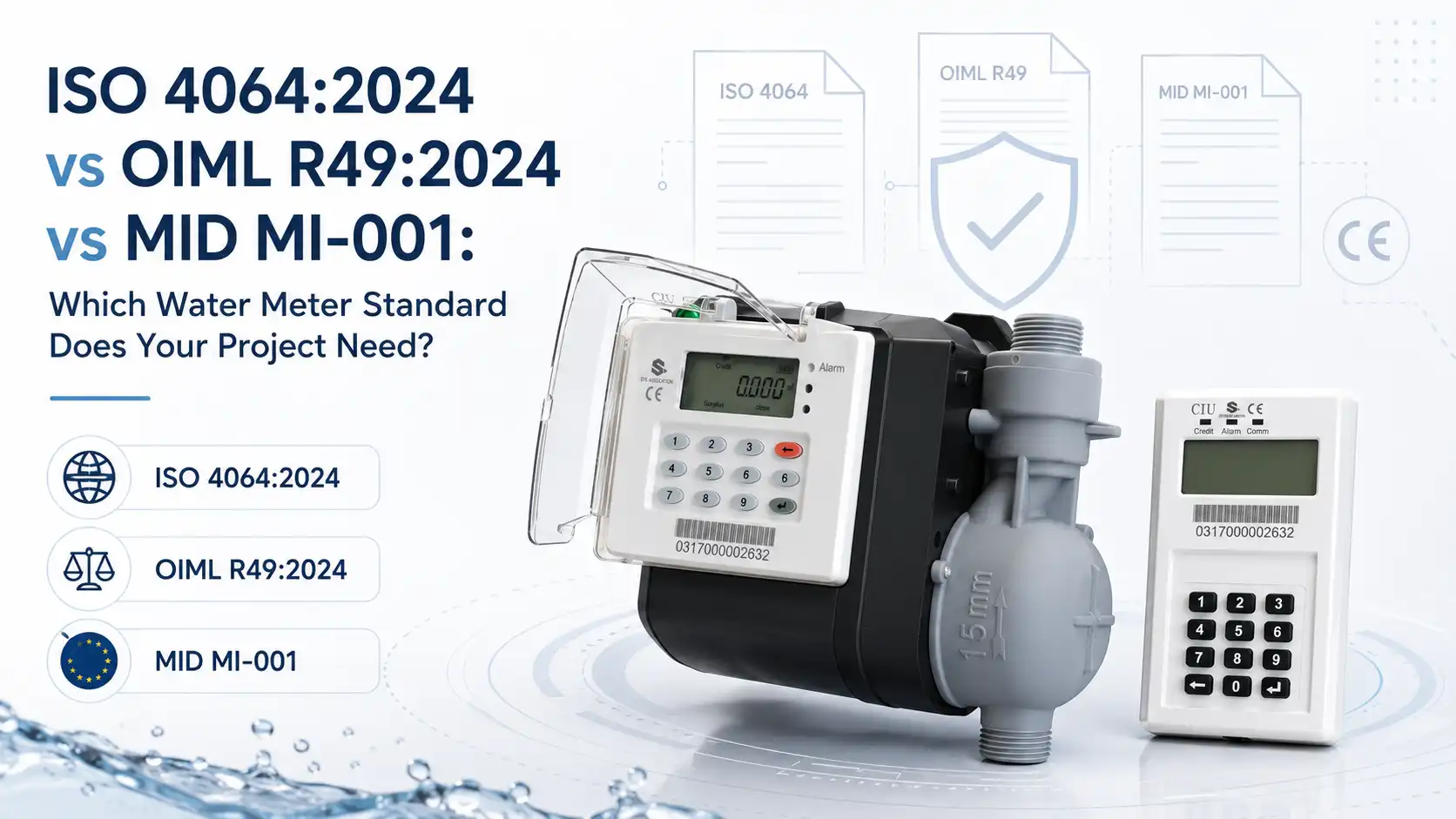
The ISO 4064 vs OIML R49 comparison gets harder when MID MI-001 enters the same RFQ. They are not three interchangeable certificates. A technical claim does not automatically grant legal market access, and phrases such as ISO approved or CE certified reveal very little without a model, scope, issuing body, and type approval record. ISO develops standards but does not certify products. For any water meter certification decision, the destination market and intended use come first.
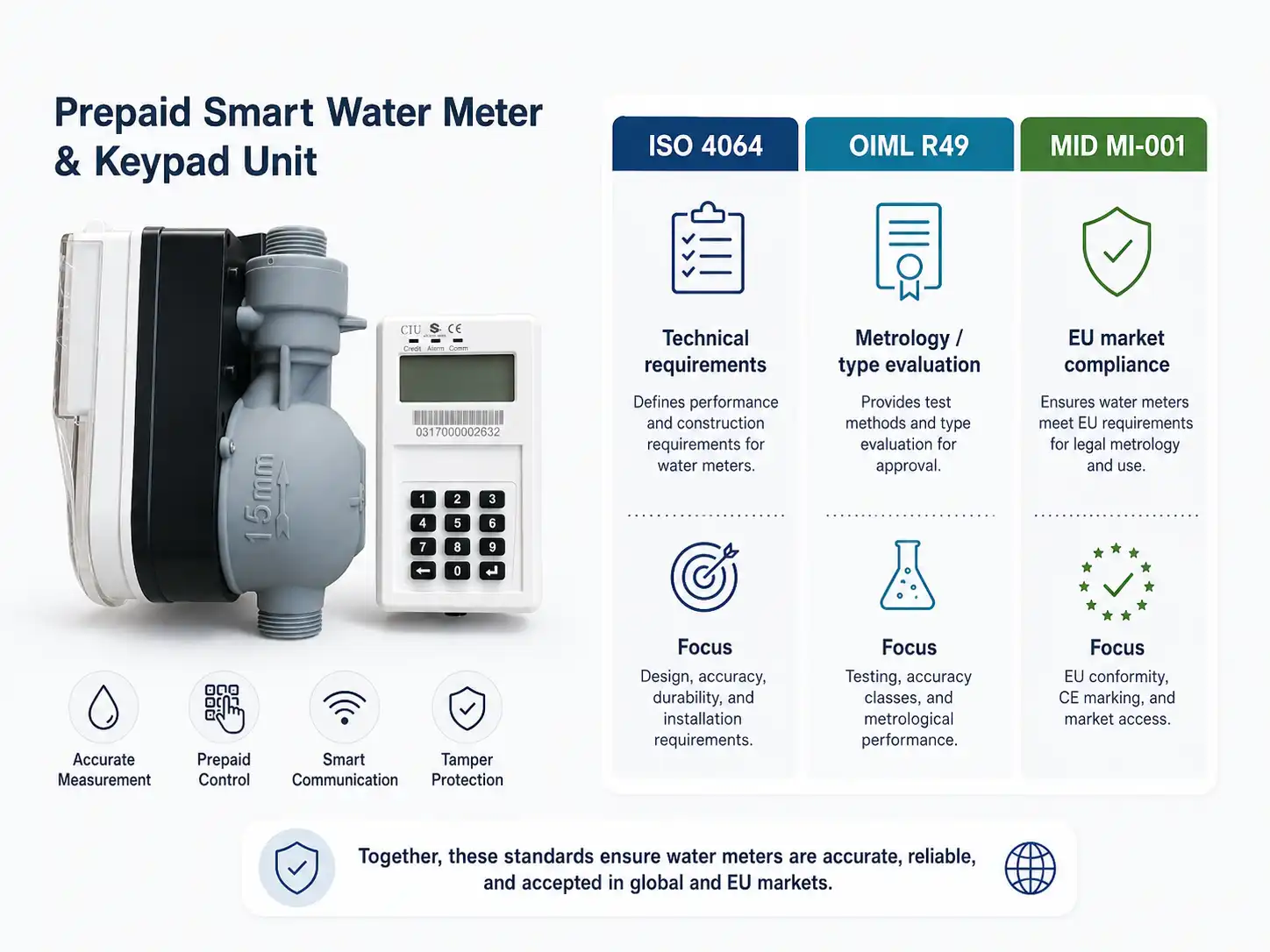
Separate these water meter standards by asking what each document does. One sets technical requirements, one supports legal metrology, and one forms part of the EU regulatory route.
| Item | ISO 4064 | OIML R49 | MID MI-001 |
| Document type | International standard | International legal-metrology recommendation | EU regulatory framework |
| Main purpose | Technical and metrological requirements | Type evaluation and legal metrology | EU conformity for water meters in scope |
| A product certificate by itself | No | No | Requires the applicable conformity assessment |
| Uses Q1, Q2, Q3, Q4 | Yes | Yes | Yes |
| Buyer should verify | Test basis and report | Certificate plus type evaluation report | Conformity documents and declaration |
ISO 4064 states how a meter should perform and be tested. OIML R49 supports legal-metrology evaluation and type documentation. MID MI-001 governs the conformity route for covered EU water meters. Suppliers with documented water meter manufacturing and certification capabilities should identify which evidence supports each claim.
ISO 4064-1:2024 covers meters that indicate accumulated cold potable-water or hot-water volume in a fully charged, closed conduit. Its scope includes mechanical meters, electronic meters, mechanical designs with electronic devices, and certain ancillary electronic devices.
Part 1 covers metrological and technical requirements. Part 2 provides test methods, Part 3 standardizes test reports, Part 4 addresses other requirements, and Part 5 covers installation. A Part 1 claim alone leaves the report, installation conditions, and tested configuration unresolved.
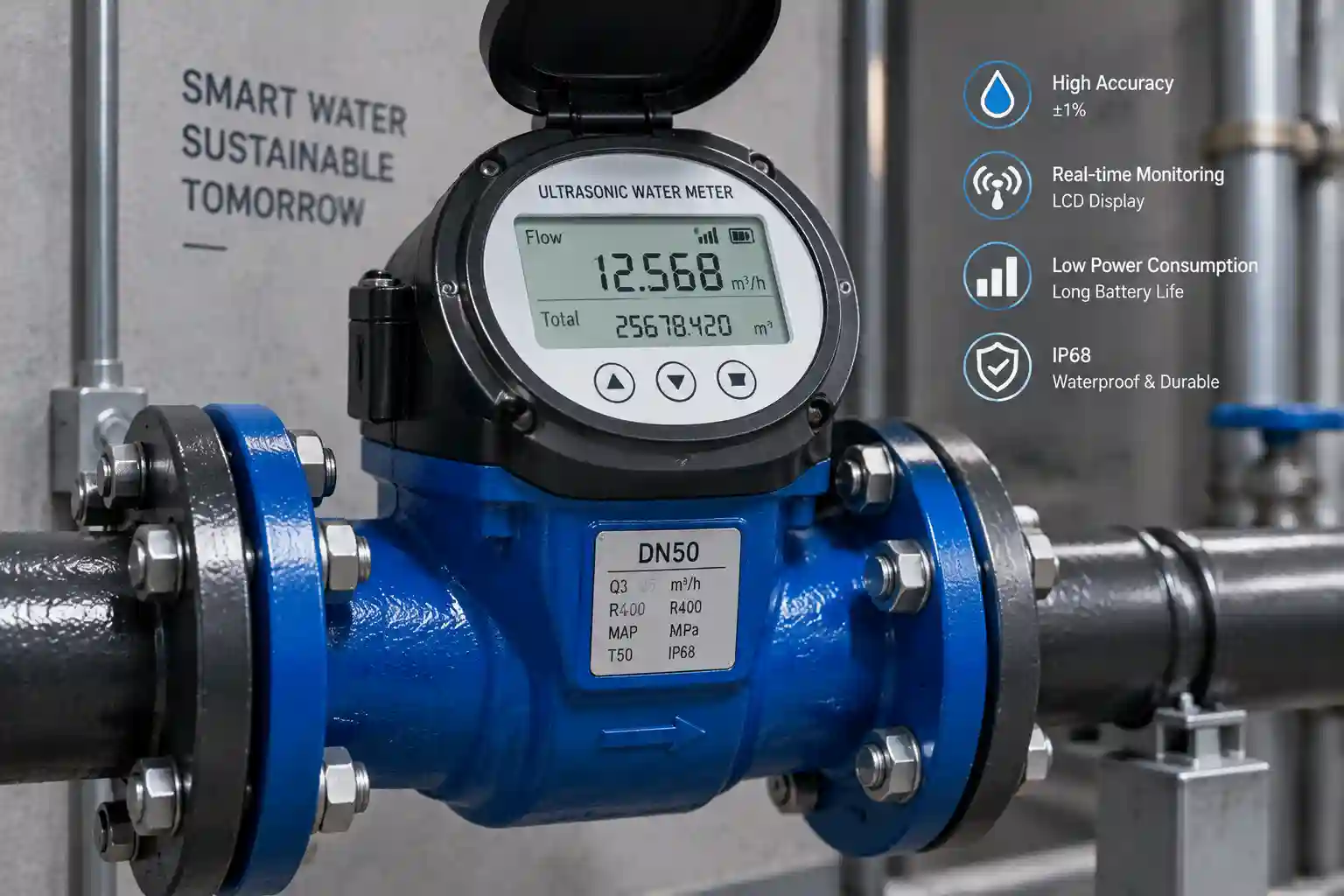
Check Q1 minimum flow, Q2 transitional flow, Q3 permanent flow, Q4 overload flow, R-ratio, permissible error, temperature and pressure classes, pressure loss, orientation, environment, and durability. The enterprise material defines R as Q3 divided by Q1. It also lists manufacturer, model, DN, Q3, installation method, accuracy information, serial identity, and flow direction as meter markings.
No. A manufacturer may declare compliance. A report records tests on identified samples and clauses. A certificate should name its issuer, model, edition, and scope. ISO neither performs certification nor issues certificates. Inspect the evidence behind every ISO 4064 compliant claim.
OIML R 49-1:2024 closely aligns with ISO 4064 in scope and terminology. It covers cold potable-water and hot-water meters in full closed conduits, including mechanical and electronic designs. Its role sits closer to legal metrology, where authorities evaluate a type before approving it for regulated use.
OIML R49 is the recommendation. A type evaluation report records the evaluated design and results. An OIML-CS certificate links an eligible issuing authority to that report. The system issues and registers these records. A certificate can support national approval, but local law, the authority, tender, and installation purpose still decide acceptance.
The Measuring Instruments Directive is Directive 2014/32/EU. Annex III, MI-001, applies to meters intended to measure clean cold or heated water in residential, commercial, and light-industrial use. It defines Q1 through Q4 and addresses errors, rated conditions, temperature, pressure, durability, electromagnetic environment, and conformity assessment.
Check whether MI-001 applies, the completed conformity route, notified-body information where applicable, the EU Declaration of Conformity, and the model across the nameplate and documents. A generic electrical-safety or EMC file does not prove MID metrological conformity. Apply the same discipline to rotary mechanical water meters for residential and commercial projects.
An ISO 4064 vs OIML R49 comparison finds common concepts such as Q1 to Q4, R-ratio, metrological performance, environment, testing, and durability. Their roles differ. ISO 4064 is an international technical standard; OIML R49 is an International Recommendation for legal-metrology evaluation. Adoption and approval routes remain market-specific.
The edition year matters. ISO lists ISO 4064-1:2014 as withdrawn and ISO 4064-1:2024 as published. OIML also issued R49:2024. A tender may still cite an older edition, while a new certificate may cover a newer one. Ask the authority whether the cited edition, a transition rule, or an accepted equivalent controls the project.
Start with legal use, destination, and tender wording. Municipal billing can require local legal metrology, type approval, Q1 to Q4, R-ratio, and batch acceptance. European residential and commercial projects should check MI-001 and EU documents. Government tenders may request ISO 4064, OIML R49, national approval, import certification, or water-contact evidence.
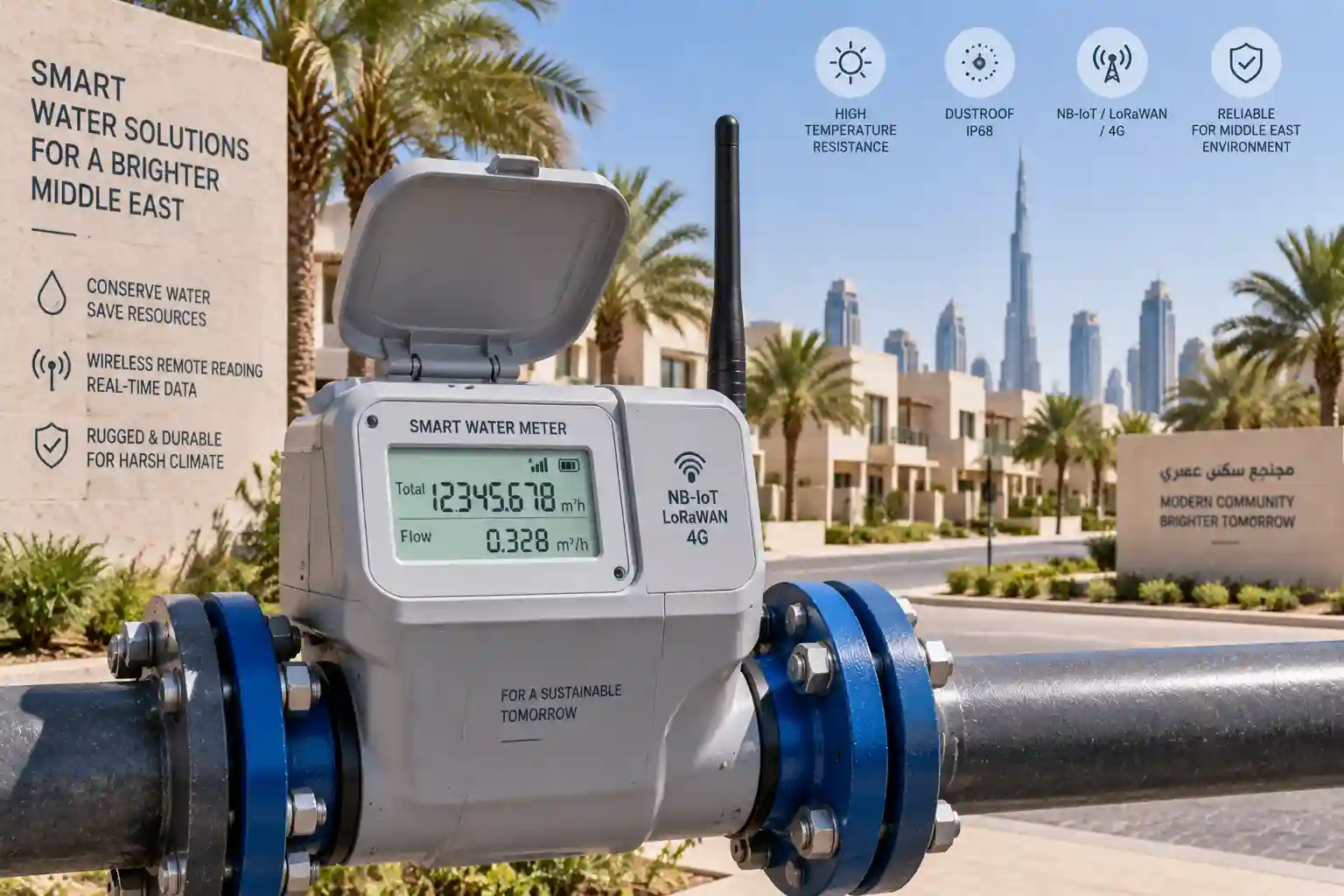
Regional labels are unreliable. Projects vary by country, tender, importing authority, and use. Private process monitoring may follow a technical specification, while trade settlement or utility billing can trigger legal control.
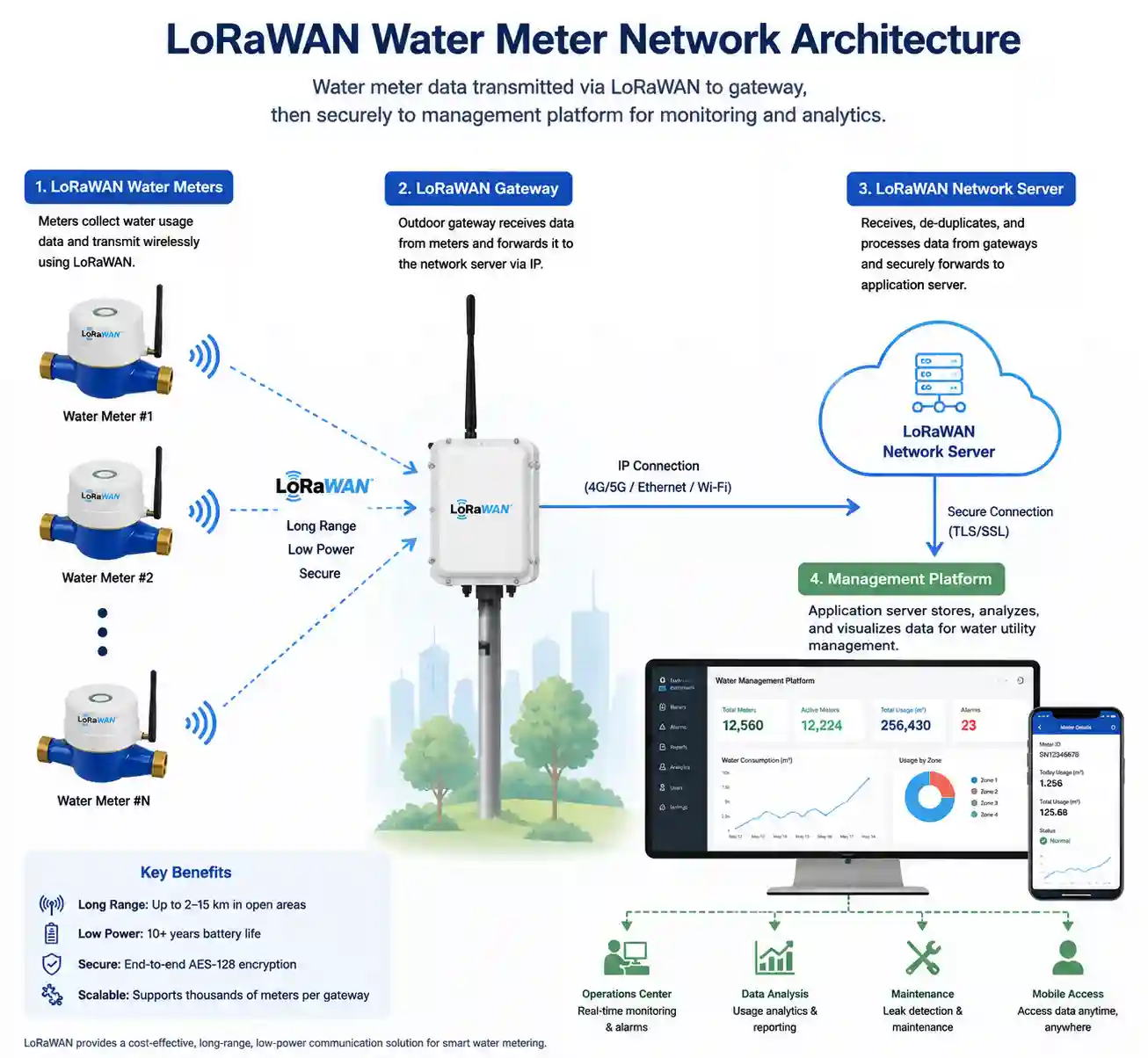
A prepaid communication standard does not replace metrological approval. The XT815 material states IEC 62055 STS support, Class 2 accuracy, Q3 by DN, and R250 for the ultrasonic version versus R100 for the mechanical version. Those specifications do not establish ISO 4064, OIML, or MID approval without model-specific documents.
The document pack should connect the quoted meter, tested type, production unit, and target-market rule. Request it before sample or bulk approval.
Type testing evaluates the design. Factory inspection checks production output; batch sampling and individual calibration serve other acceptance needs. The enterprise material records flow-error testing at Q1, Q2, and Q3, sealing checks, manuals, reports, certificates, training, warranty, and maintenance support.
A clean PDF is not proof by itself. Verify it against the actual meter and, where possible, the issuer’s registry. If low-flow performance drives selection, compare the approved scope before reviewing ultrasonic water meters for high-accuracy metering projects.
Reject cropped screenshots and unexplained model substitutions. ISO 9001 covers a quality management system; it does not prove that a water meter meets ISO 4064. A test report is also not automatically a type approval.
Document shortcuts cause many procurement failures. Examples include treating ISO as the certifier, equating ISO 9001 with product approval, calling R49 a certificate, or accepting a CE logo as MID evidence. Buyers also miss the edition, manufacturer, model, DN scope, or document review before bulk production.
Write the RFQ around the installation and legal task. State the destination, billing or monitoring use, cited standard edition, national approval, Q3 and R-ratio, temperature and pressure classes, orientation, communication, material-contact rules, evidence required, sample plan, and batch acceptance method. This gives bidders the same target and exposes document gaps early.
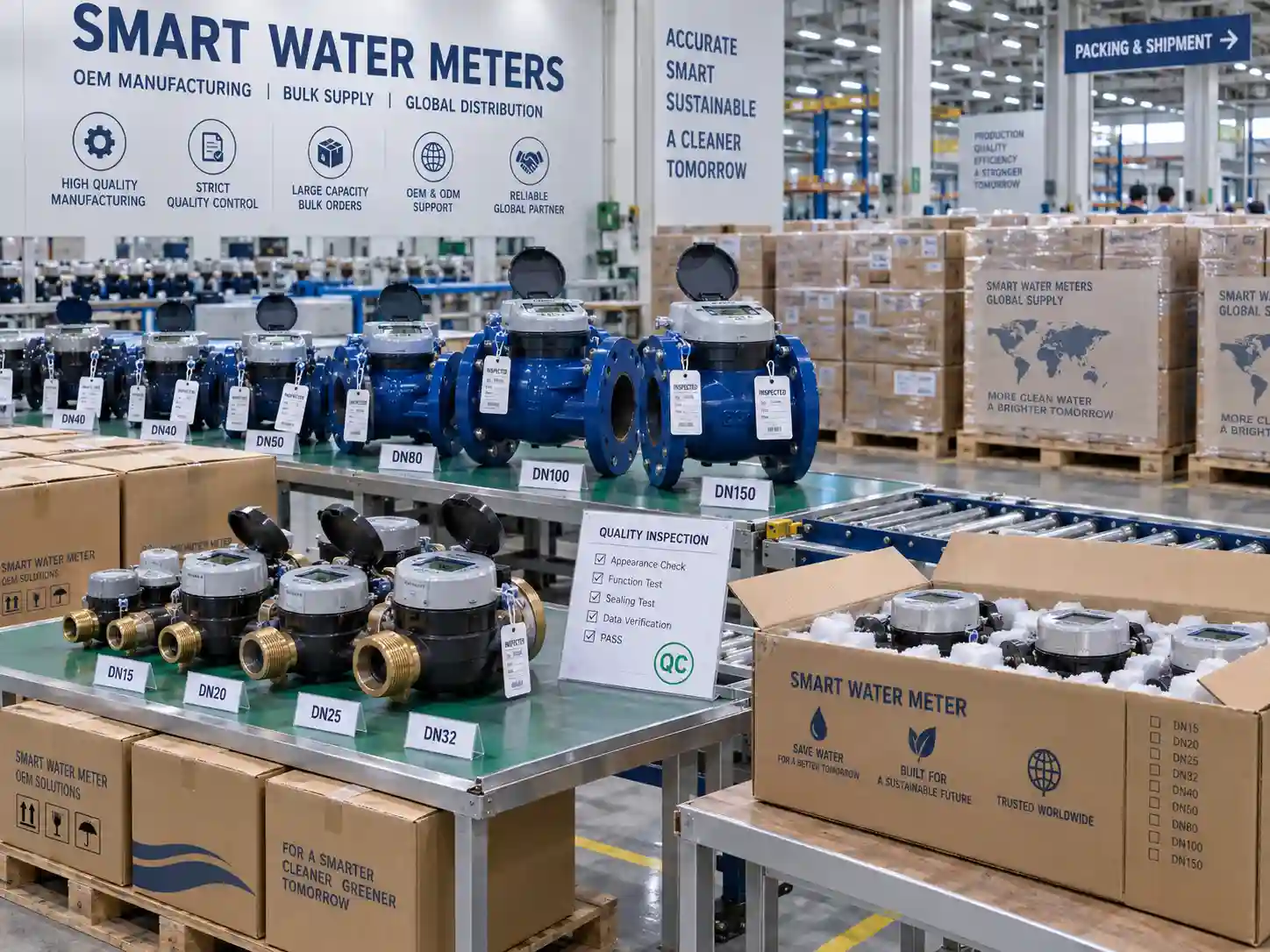
Chenshuo manufactures mechanical, ultrasonic, electromagnetic, remote-reading, and prepaid water meters for municipal, residential, commercial, and industrial applications. Its enterprise material lists ISO 9001, ISO 14001, and ISO 45001 management-system certifications, along with OEM support for caliber, material, accuracy class, functions, labeling, packaging, and trial or volume production. It also describes manuals, test reports, certification documents, technical training, warranty, and maintenance support. Buyers should still verify every product claim against the exact model and market requirement. A broad product range helps with selection, but it does not replace regulatory review.
These answers cover document questions that delay tenders and shipment approval. The municipal water meter procurement and selection guide can help define operating conditions before the RFQ.
Q1: What Is the ISO 4064 vs OIML R49 Difference?
A: ISO 4064 is an international technical standard for requirements, testing, reports, and installation. OIML R49 is an International Recommendation used in legal metrology and type evaluation. Their content aligns closely, but their roles and national acceptance routes differ.
Q2: Is ISO 4064 a Water Meter Certificate?
A: No. ISO 4064 is a standard, and ISO does not certify products. A supplier may provide a declaration, laboratory report, or third-party certificate. Check the issuer, model, DN scope, edition, and validity before accepting it as project evidence.
Q3: Does an OIML Certificate Guarantee Approval in Every Country?
A: No. An OIML-CS certificate and type evaluation report can support national approval. The destination law, legal-metrology authority, import rules, tender, and intended use determine whether authorities accept it or require further approval and testing.
Q4: Is CE Marking the Same as MID Certification?
A: No. For a covered meter, verify the MI-001 conformity assessment, metrology marking, notified-body information where applicable, EU Declaration of Conformity, and model match. A CE logo or generic electrical document does not establish MI-001 metrological compliance.
Q5: What Documents Should a Buyer Request Before Ordering Water Meters?
A: Request the model datasheet, certificate and scope, type evaluation or test report, required conformity declaration, nameplate drawing, OEM cross-reference, and batch inspection or calibration records. Confirm them before approving samples or releasing a bulk order.
 Address: Xiao'anzi Industrial Park, Baishabu Town, Lanshan District, Linyi City, Shandong Province
 Call us now:+86 15562945993
 Email:info@sdchenshuo.cn


Shandong Chenshuo Instrument Co., Ltd.