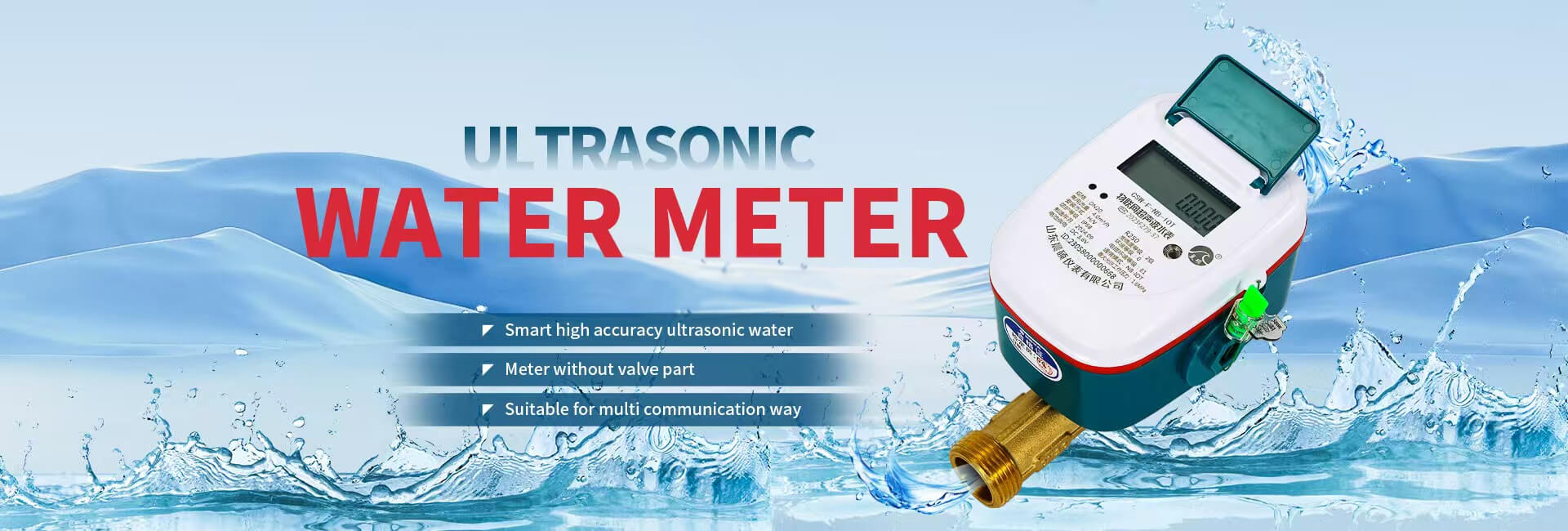


Non-revenue water (NRW) is the difference between the volume entering a water supply system and its billed authorized consumption over the same period. It includes physical leaks, apparent losses such as customer meter inaccuracies, and authorized water use that is not billed. Smart water meters help operators find and investigate these losses through better consumption records, suitable low-flow measurement and earlier warnings.
Buying connected meters does not, by itself, lower NRW. The useful question is which loss the project needs to address, what evidence the meter can provide, and who will act on it. A leak repair and a billing correction can both improve the water balance, but they solve different problems.

Start with one boundary and one reporting period. Identify the supply points entering that boundary, transfers leaving it, and the customer accounts it contains. Check bulk-meter accuracy and reconcile reading dates before comparing supply with billed consumption. A period mismatch can make the balance look worse without any new leak.
NRW volume = system input volume − billed authorized consumption.
NRW percentage = NRW volume ÷ system input volume × 100.
For a hypothetical month, suppose system input is 100,000 cubic metres and billed authorized consumption is 75,000 cubic metres. NRW is 25,000 cubic metres, or 25%. That calculation identifies a gap; it does not establish how much escaped from pipes.
The EPA water-audit framework separates physical losses from customer-meter and data-handling errors. Its categories help operators connect a number on a report to the work needed in the field. For the leakage branch, understanding how smart water meters detect potential leaks helps explain what an alarm can, and cannot, establish.
| NRW component | What it includes | Appropriate response |
| Real losses | Leaking mains, storage overflows and service-connection leakage up to the customer meter | Locate the loss, repair it and verify the change |
| Apparent losses | Customer meter inaccuracies, unauthorized consumption and systematic reading or billing errors | Test meters, reconcile records and investigate connections |
| Unbilled authorized consumption | Approved uses such as unbilled firefighting or main flushing | Measure or estimate the volume and record its purpose |
Unbilled authorized consumption is part of NRW, although the use may be necessary. Treating all of it as avoidable waste would distort the action plan. Similarly, water that has been billed but remains unpaid is a collection issue; it does not become additional volumetric NRW simply because the invoice is outstanding.
The meter boundary also matters. A leaking toilet downstream of a customer meter may waste water, yet if the meter records that volume and the utility bills it, the volume is billed consumption. Helping that customer repair the leak supports conservation without necessarily reducing the utility’s NRW.
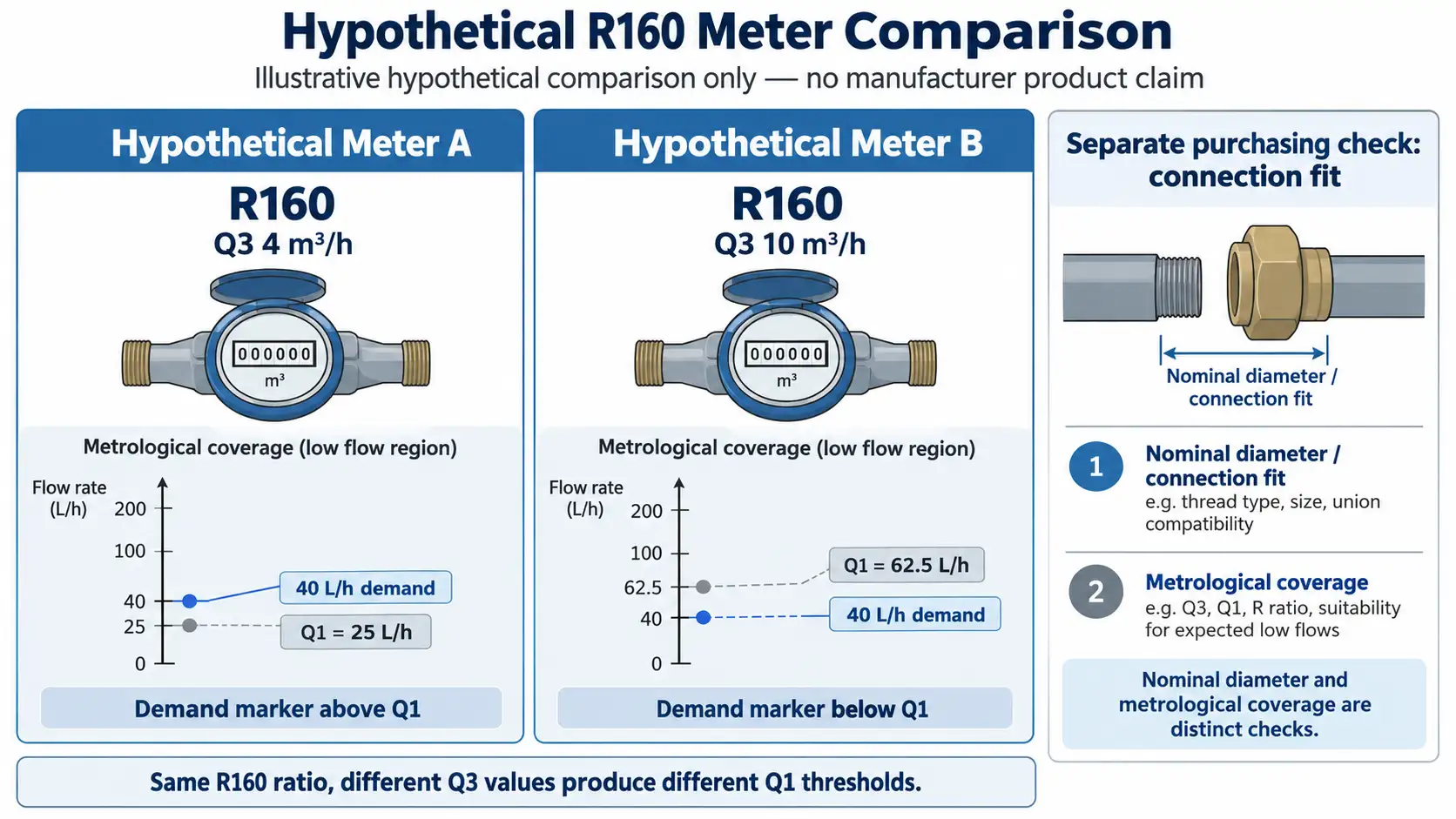
A meter can fit the pipe and still be poorly matched to demand. Much of the consumption may pass at low rates, particularly where storage tanks refill slowly. Mechanical wear and contamination can also affect registration. A replacement decision should therefore consider the demand profile and test results, rather than pipe diameter or installation age alone.
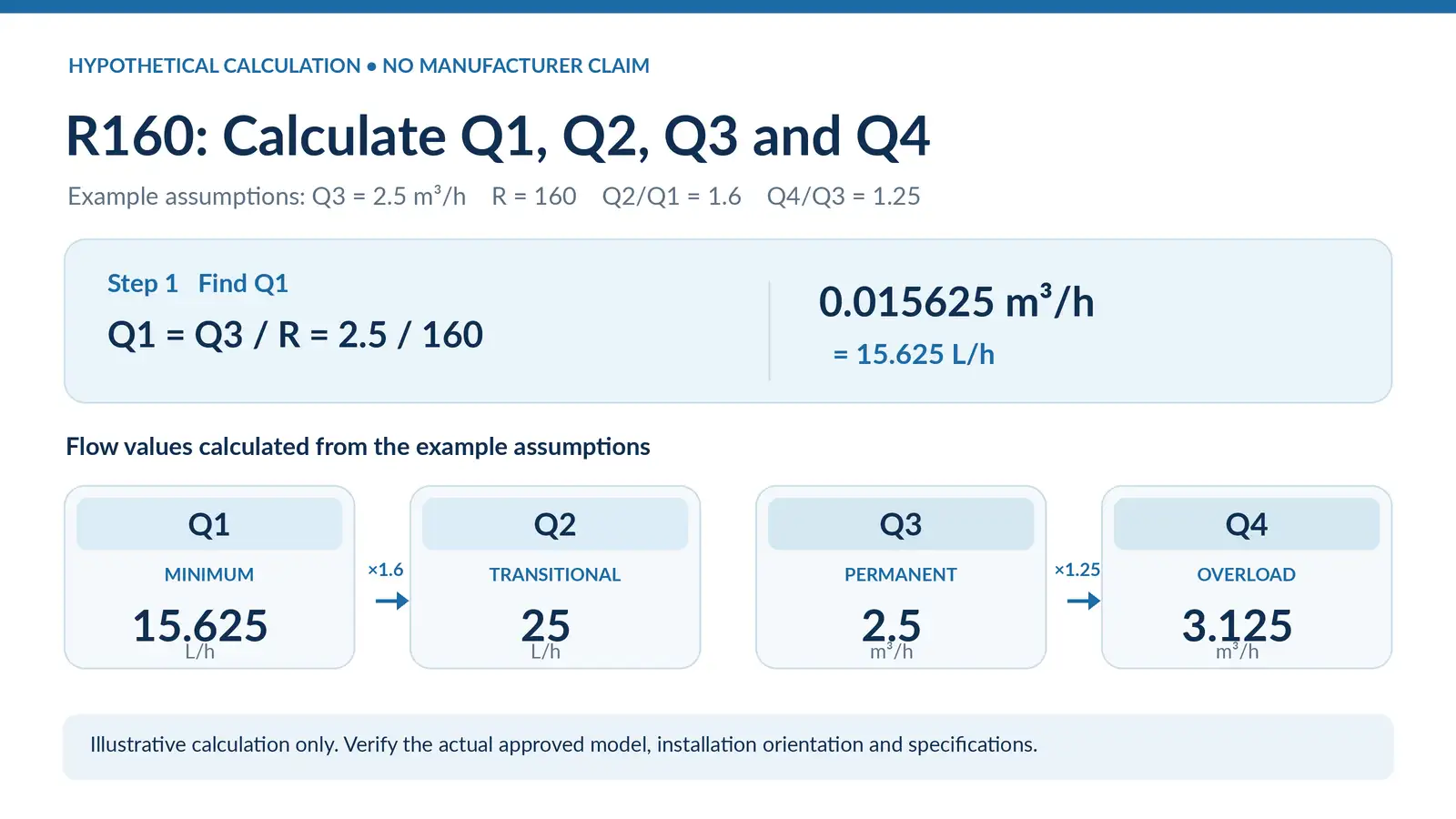
Check permanent flow Q3, minimum flow Q1 and the ratio R = Q3/Q1. At the same Q3, a higher approved R corresponds to a lower Q1. It does not guarantee accurate measurement at every smaller flow, and the approved installation position must match the site.
Communication and measurement are separate specifications. Adding a radio to an existing mechanical meter does not repair its measuring mechanism. Buyers need evidence for both the meter’s performance and the delivery of its readings.
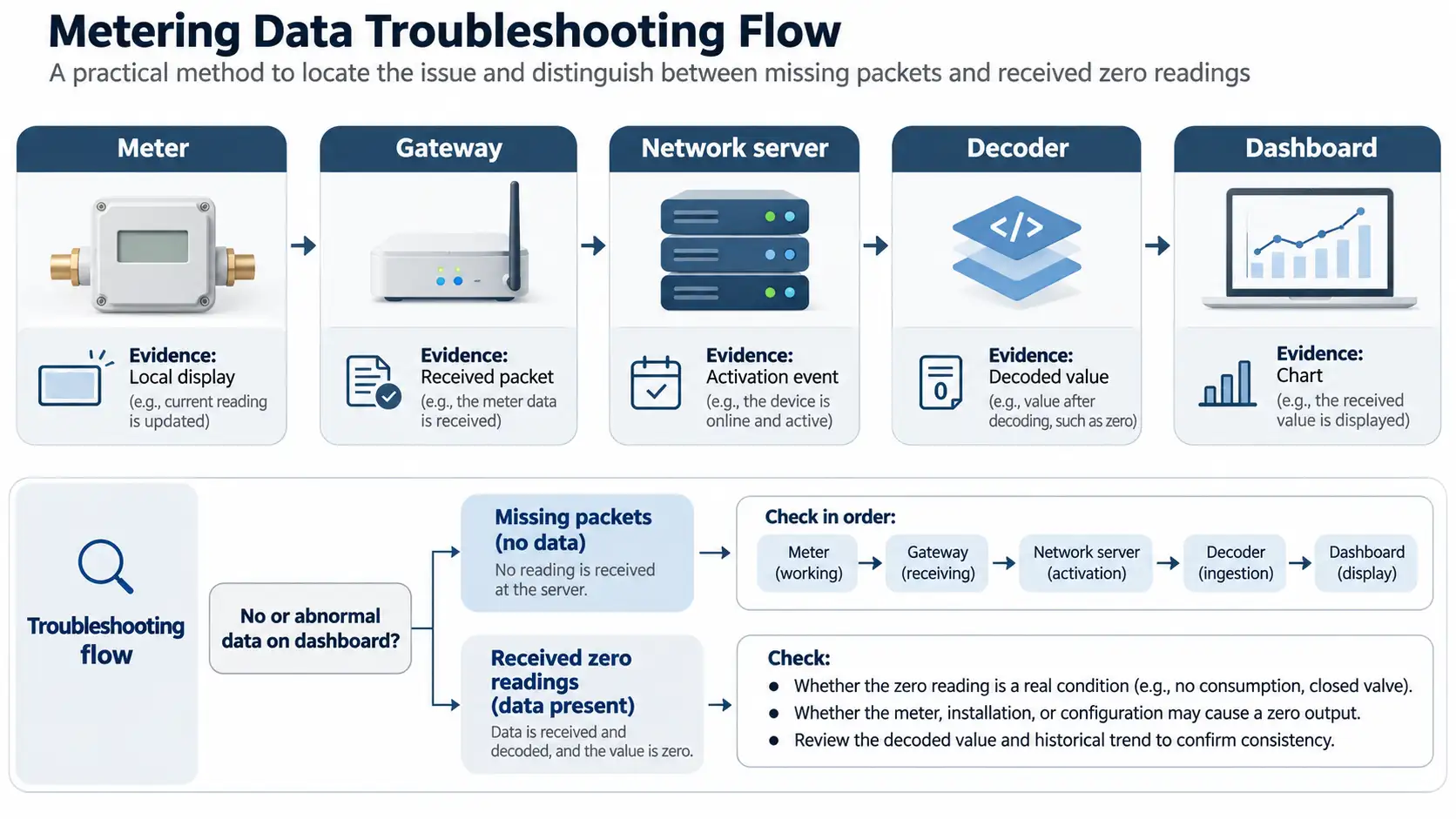
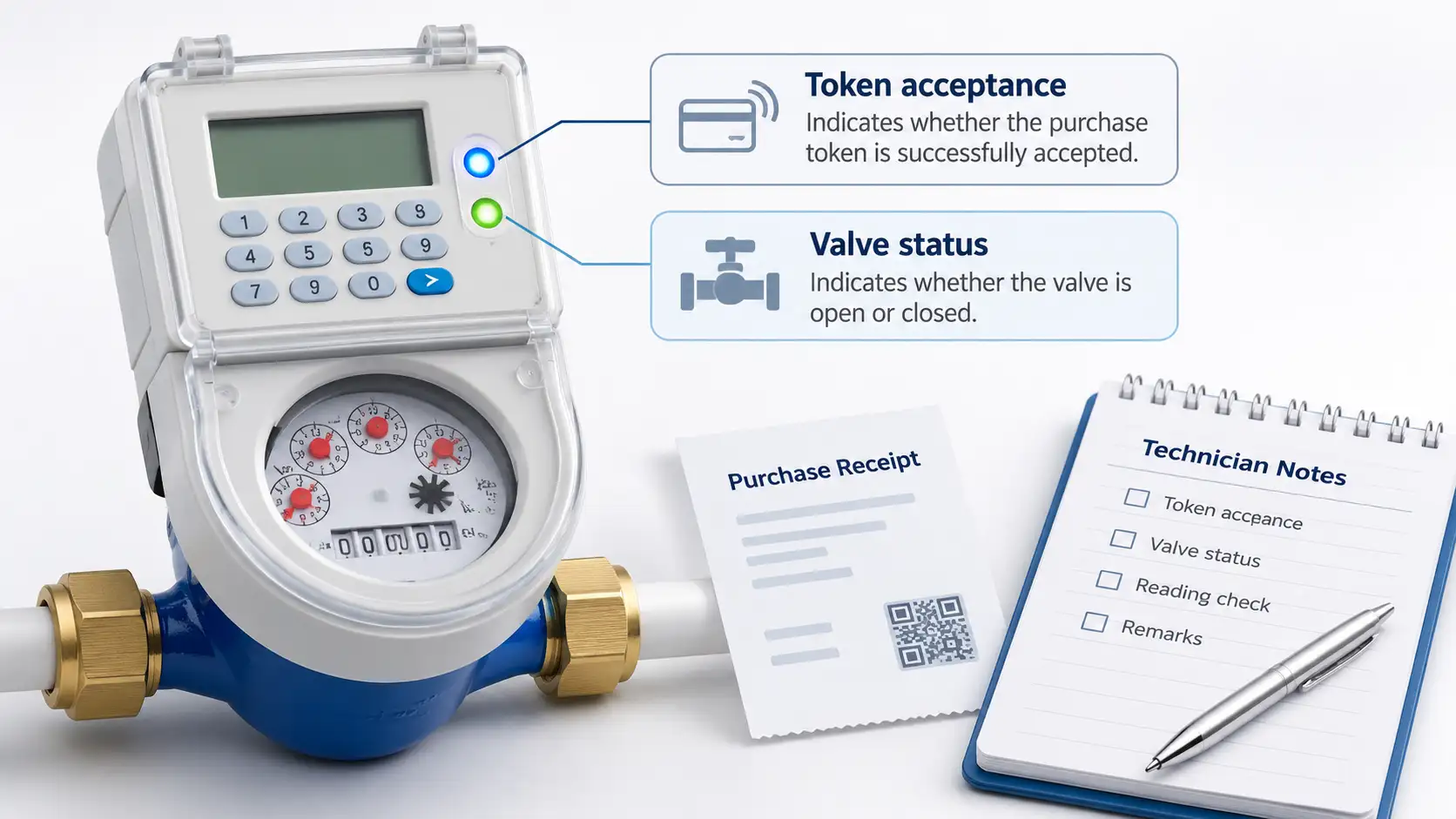
Automated collection can reduce manual transcription, but an incorrect device-to-account mapping can still produce a wrong bill. Compare the physical serial number, local cumulative register, received value and billing record during commissioning. Confirm units and any configured multiplier before accepting the connection.
Keep meter-change records as well. An unexplained register reset can resemble falling consumption when it actually marks a replacement. Save the removed meter’s closing reading, the new meter’s opening reading and the effective date so the billing team can reconstruct the period.
Repeated readings can show patterns that a monthly total hides. Persistent flow during normally quiet hours may justify an inspection, especially when occupancy and operating schedules have not changed. The alarm should identify the meter and event time clearly enough for someone to check the premises.
For example, the XT815-U ultrasonic water meter includes continuous small-flow monitoring and empty-pipe detection. Remote communication is configuration-dependent. These functions provide different evidence: sustained flow can trigger a leak investigation, while an empty-pipe warning can indicate that a zero reading needs installation checks.
An alarm alone does not pinpoint a buried break. Inspect accessible fittings, compare operating schedules and use the appropriate leak-location method before excavating. Where valve control is available, agree operating authority and customer-service rules before linking alarms to shutoff actions.
A district metered area, or DMA, has defined boundaries and measured supply connections. Comparing its inflow with customer consumption helps narrow the investigation area. Night-flow analysis can be useful, provided legitimate overnight demand, boundary transfers and storage changes are considered.
Align the observation windows. Comparing a district’s hourly inflow with customer totals from different days produces a misleading residual. Missing customer readings also need explicit flags; treating them as zero consumption exaggerates the apparent gap.
Once a crew repairs a confirmed leak, compare conditions before and after the work. Record pressure and unusual demand changes alongside the flow trend. Otherwise, a fall in consumption during a holiday could be mistaken for the result of a repair.

Choose a bounded area where the team can reconcile supply and customer records. Include ordinary connections and difficult installations, such as deep pits or basements. Keep a baseline before changing meters, and record replacements, billing corrections and repairs separately throughout the trial.
For connected deployments, testing LoRaWAN coverage and data quality provides a practical starting point. Agree what reading completeness and reporting delay the intended response requires. A system adequate for monthly billing may provide too little detail for a time-sensitive leak investigation.
Track outcomes that lead to a decision. Useful measures include valid readings received, unresolved gaps, alarms investigated, confirmed leaks repaired and tested meter errors. Give each alarm an owner and a closure record. An alert left unreviewed has not saved water.
Give the response team a usable event record: connection identity, time, recent consumption pattern, alarm status and the next inspection step. Record a finding even when the cause is legitimate overnight demand. Those closed investigations help refine alarm settings without quietly disabling warnings that are inconvenient to handle.
Keep a separate record of data-quality corrections. If a wrong multiplier is fixed during the pilot, revise the affected comparison consistently and retain the original calculation. Otherwise, the project may claim a physical water saving for a change that only corrected the records. The same discipline applies when a bulk meter is recalibrated.
Assess recovered billing volume separately from reduced physical loss. Both may improve NRW, but their economic value and operating costs differ. Include installation, communications, software, battery service and field follow-up when comparing proposals. Avoid judging the pilot only by a headline NRW percentage; changes in total demand can move that percentage too.
No. Leakage is the real-loss component. NRW also includes apparent losses and unbilled authorized consumption. A complete assessment needs meter and billing checks as well as physical leak investigation.
A customer meter can identify persistent flow through its connection. District comparisons can narrow the search area. The precise location usually requires further inspection or leak-detection equipment; a consumption alarm is an investigation lead.
Replacement can reduce apparent losses when testing confirms under-registration and the new meter suits the application. It will not repair leaking mains. Check the reason for replacement and verify the result with comparable readings.
There is no single percentage that establishes good performance for every utility. Supply pressure, network size, service conditions and data quality affect interpretation. Track absolute loss volumes and relevant operating indicators alongside the percentage.
Not necessarily. The local register may continue accumulating volume while communications are unavailable. Compare local and received readings, then check whether the configured system can retrieve missing records. Do not assume every historical interval can be recovered.
Send Chenshuo the connection sizes, expected flow profile, installation conditions, network plan and proposed acceptance checks to discuss a suitable smart-meter configuration. Identify whether the priority is customer-meter accuracy, remote reading or leak investigation so the proposed equipment
 Address: Xiao'anzi Industrial Park, Baishabu Town, Lanshan District, Linyi City, Shandong Province
 Call us now:+86 15562945993
 Email:info@sdchenshuo.cn


Shandong Chenshuo Instrument Co., Ltd.