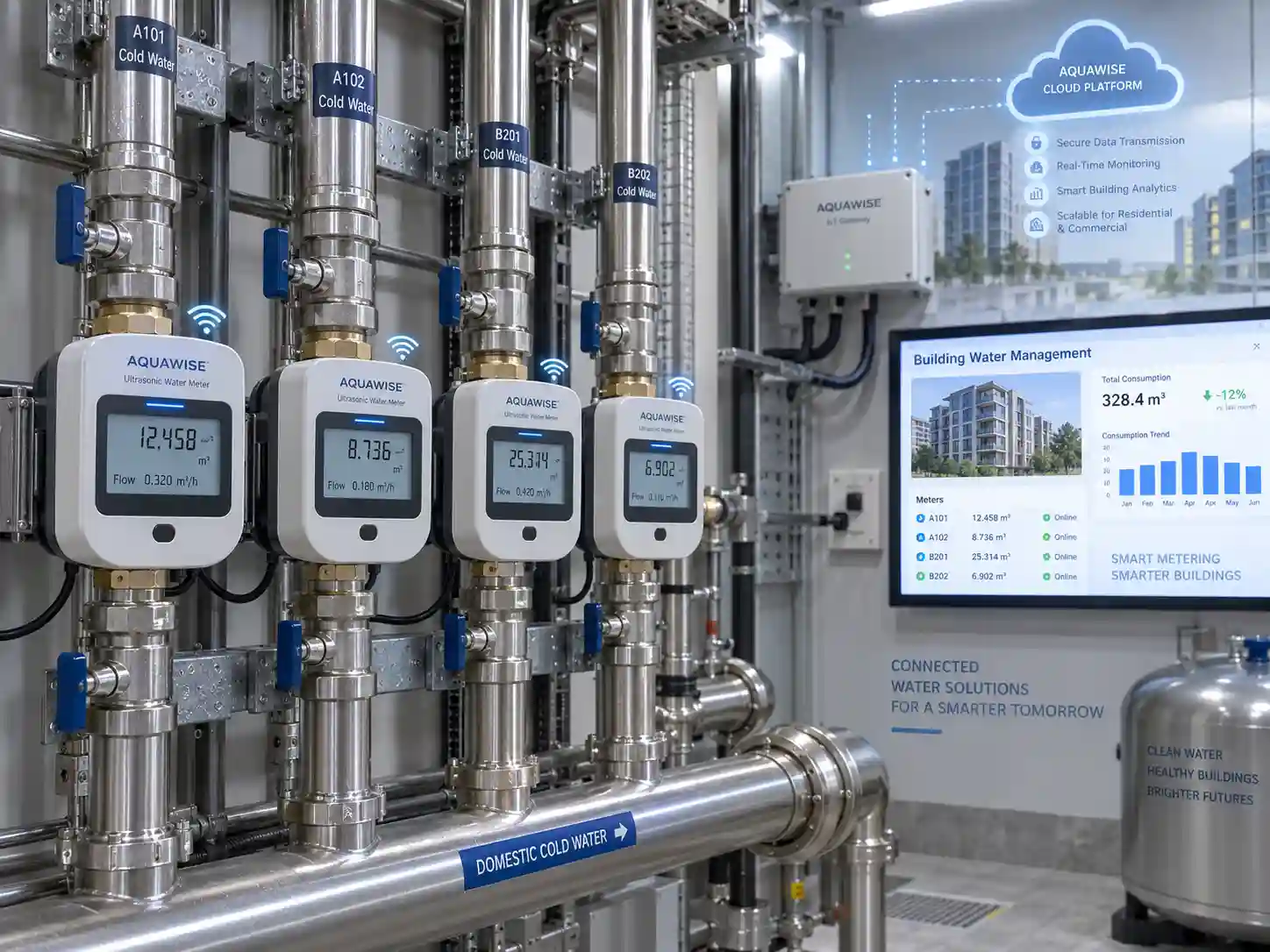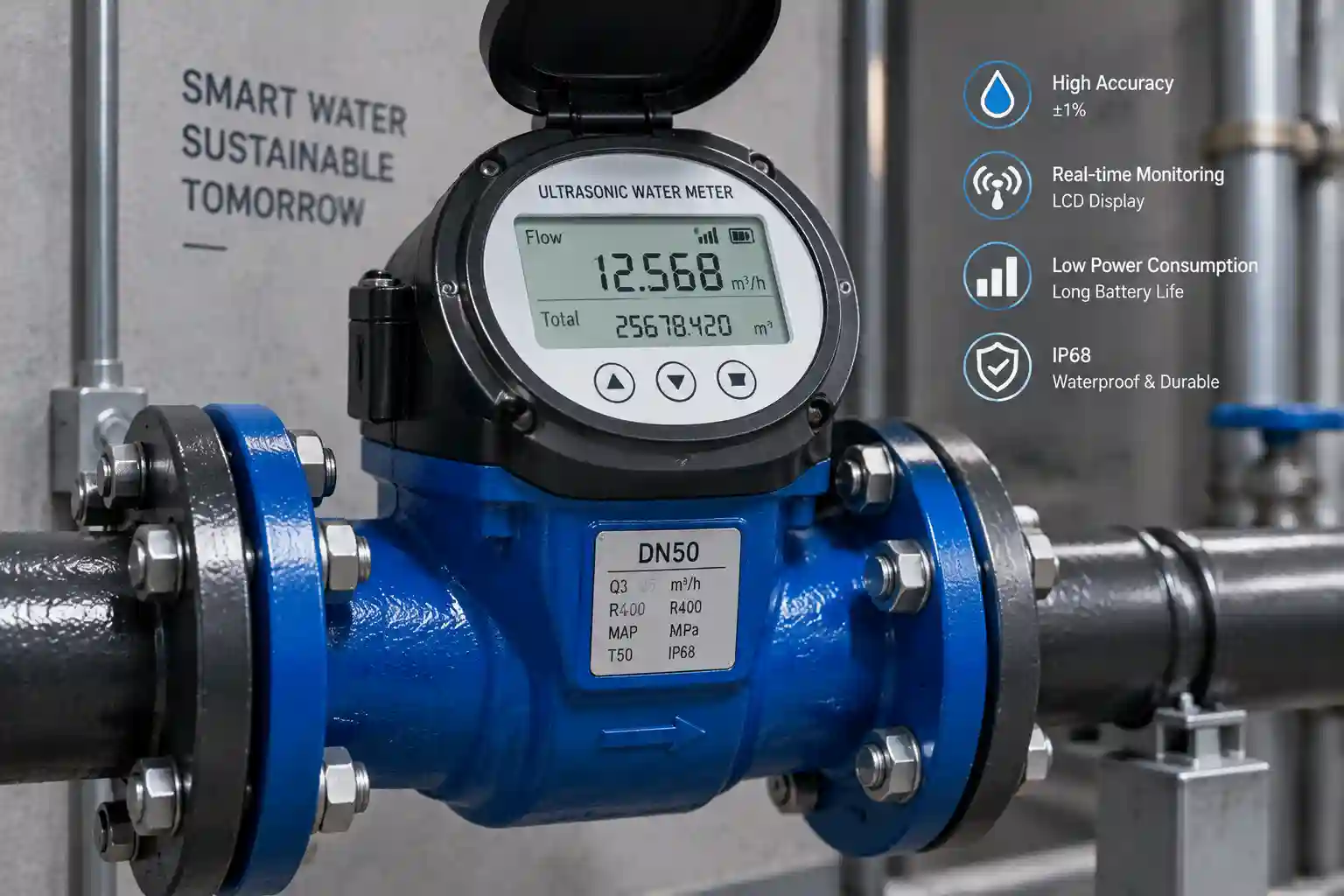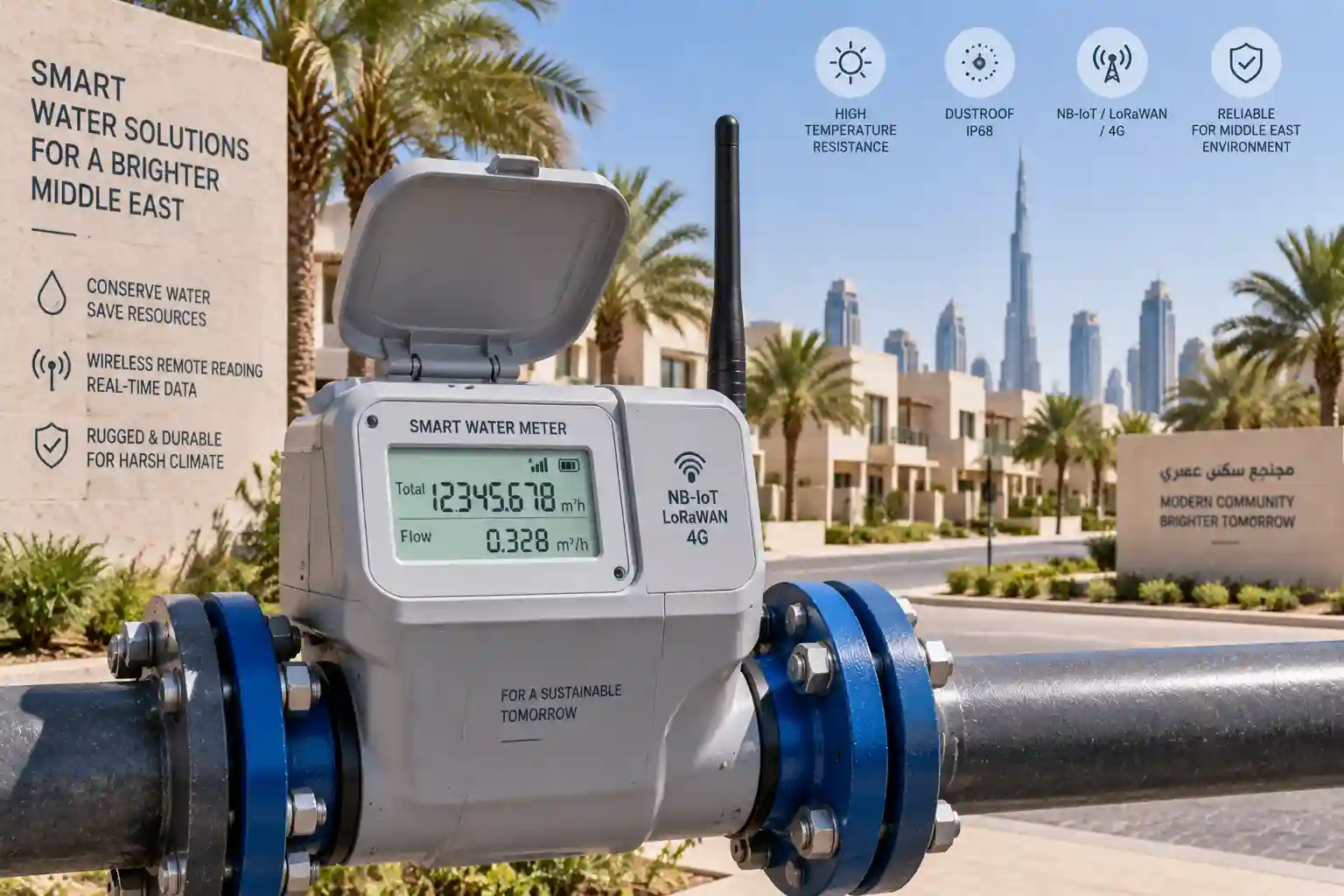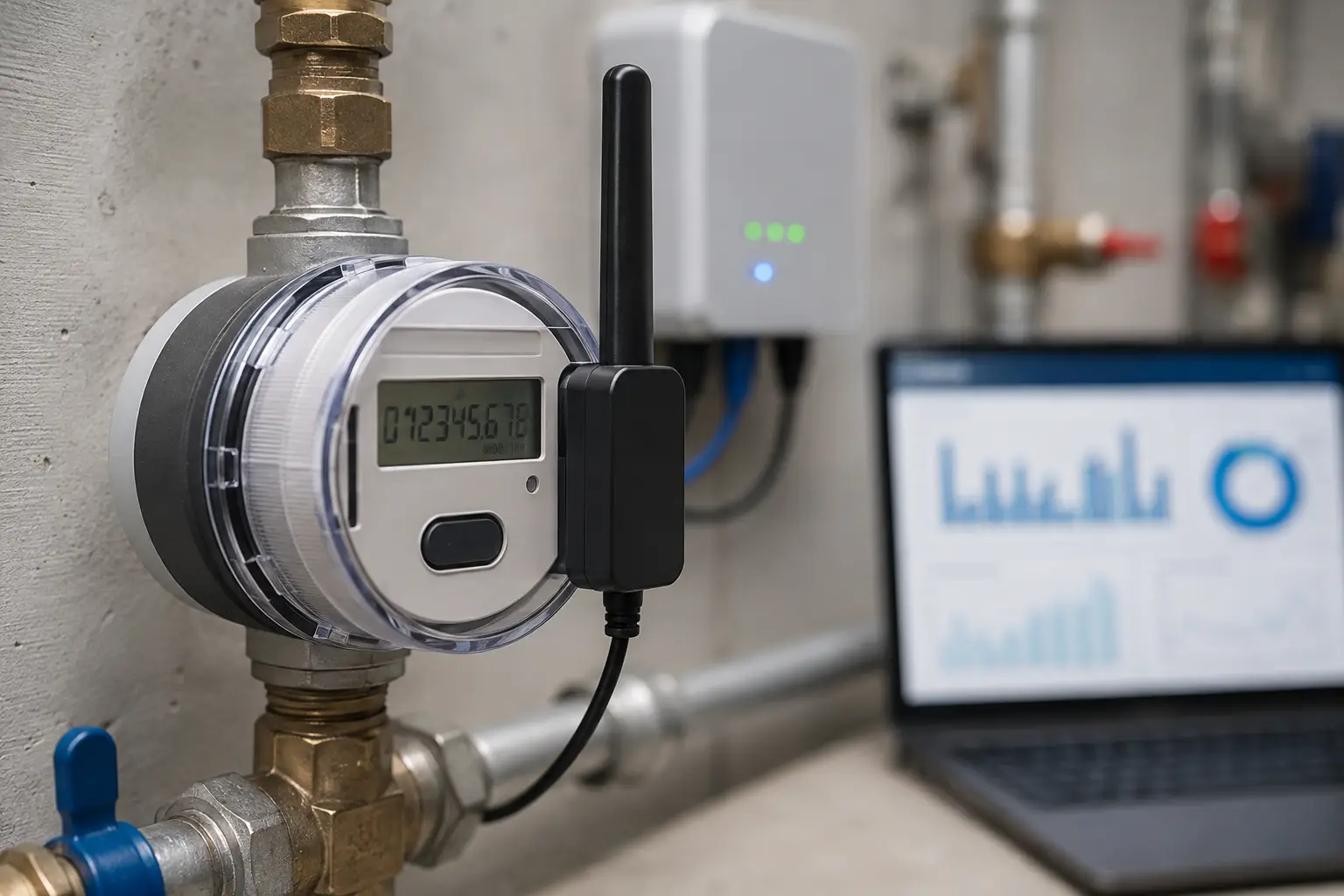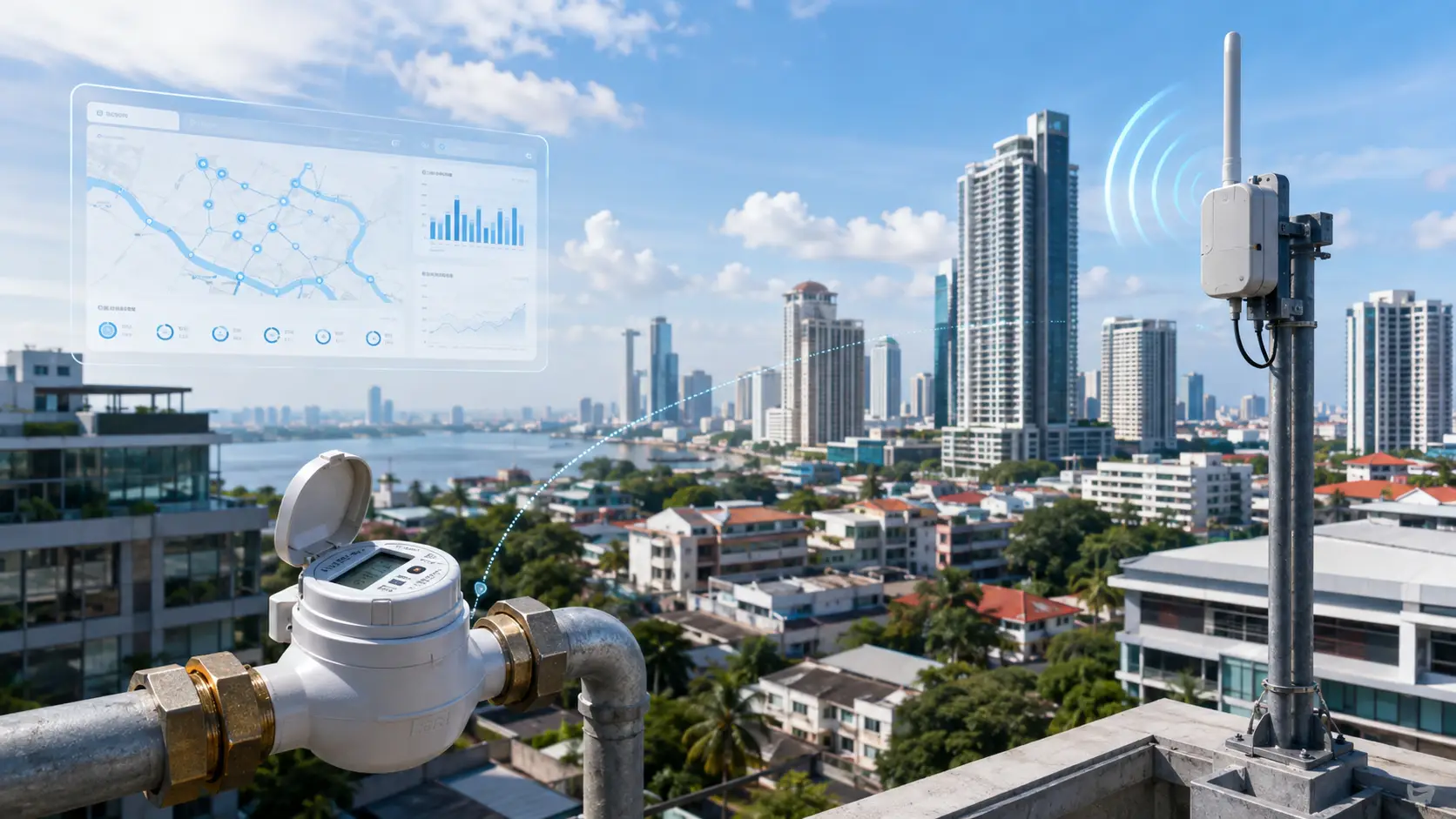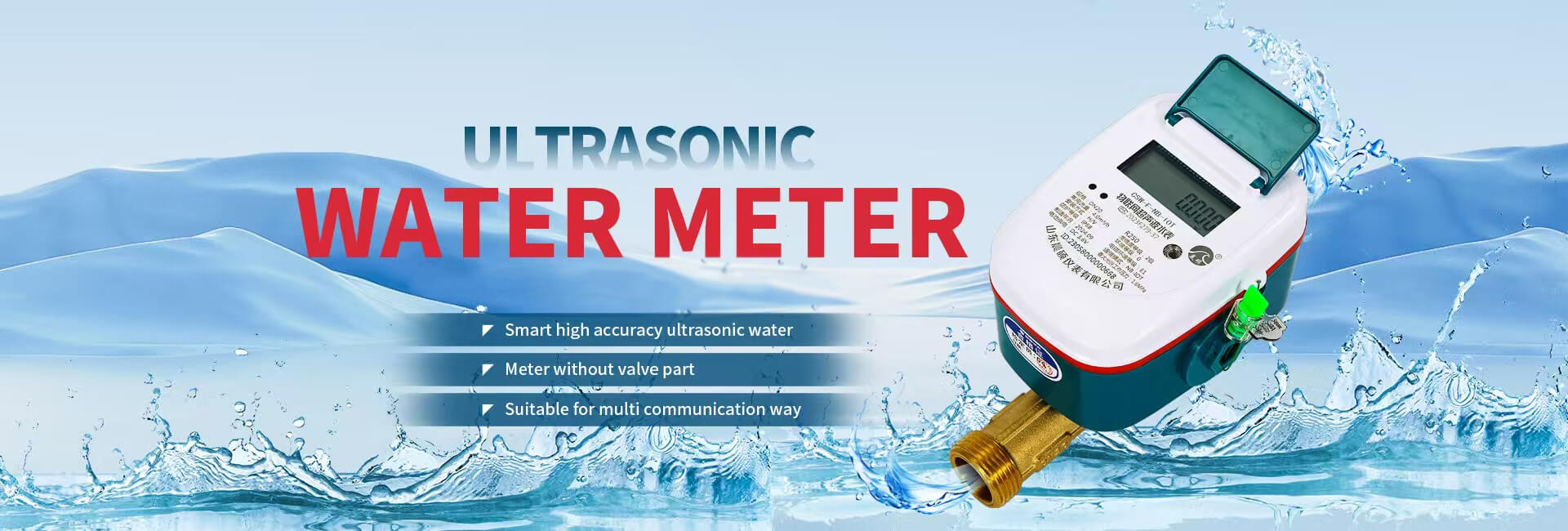


LoRaWAN Water Meter and NB-IoT Water Meter projects use different network paths. LoRaWAN fits sites where gateways can be planned and managed across a meter cluster. NB-IoT fits sites where suitable operator coverage and a cellular service plan are available. The better choice comes from the installation map, network ownership, reporting needs, platform, and long-term service model.
For a utility or building programme, compare the complete deployment package: meter, radio module, gateway or SIM service, data access, and maintenance.
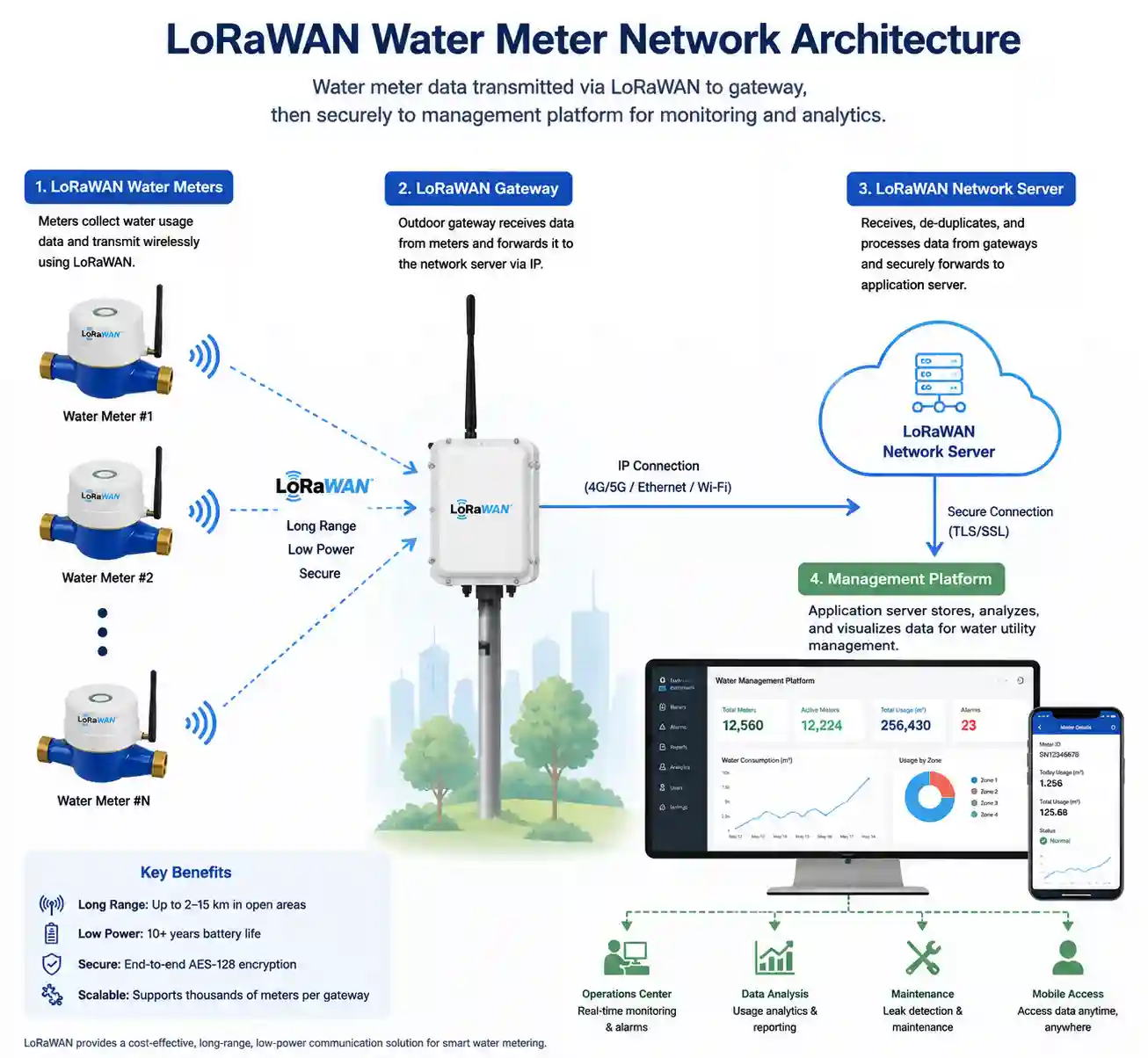
Both options carry water-consumption data from a meter to a management system. The network architecture changes how the data reaches that system and who operates the communications layer.
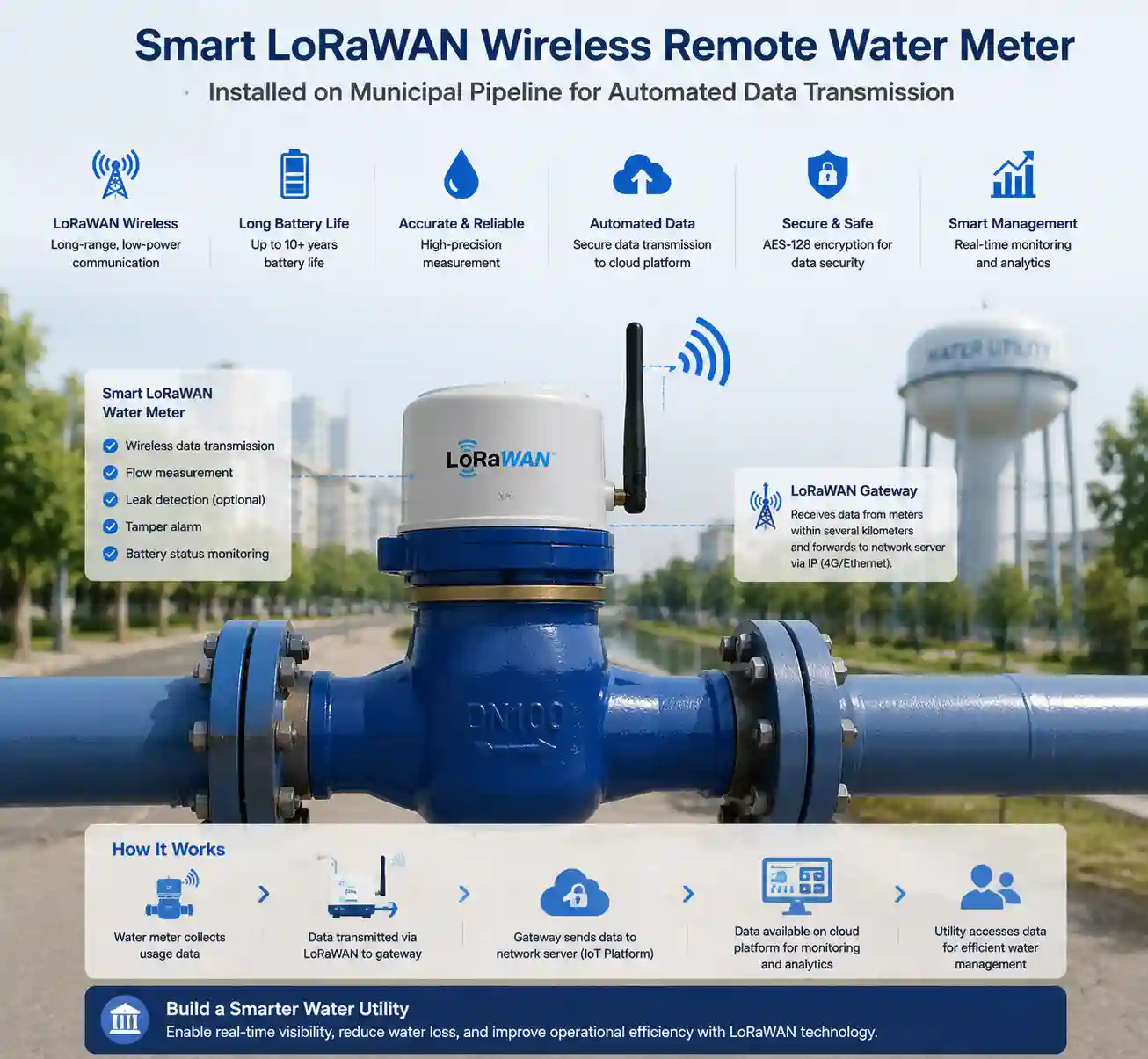
A LoRaWAN setup normally includes the meter, a LoRa radio, a gateway, a network server, and an application platform. The gateway receives messages from nearby meters and forwards them to the network. Gateway position, antenna location, walls, meter pits, lids, and local interference become part of the site plan.
An NB-IoT setup places an NB-IoT module in the meter and uses a cellular operator network to carry the data. The project then connects the device service to its application or water-management platform. Coverage, SIM or eSIM service, operator support, and data-plan terms become part of the deployment plan.
Chenshuo’s smart-water-meter material lists NB-IoT and LoRa as communication options for sending water-consumption data to a water-supply management system. Model and site confirmation remains necessary.
Coverage includes more than radio distance. It includes the equipment that creates the network, the service boundary, and the work required to verify a meter’s actual position.
| Decision factor | LoRaWAN Water Meter | NB-IoT Water Meter | What to verify |
| Network path | Gateway, network server, and application plan | Cellular operator network, SIM/eSIM, and application plan | Existing infrastructure and responsible party |
| Site coverage | Gateway position, antenna, walls, pits, lids, and local signal | Operator coverage, indoor or underground signal, and device registration | On-site signal and message-delivery test |
| Meter expansion | Several meters can share a planned gateway area | Each meter uses available cellular coverage and service | Meter density, geography, gateway or subscription plan |
| Maintenance boundary | Gateway, network service, and meter require defined ownership | Operator service and meter service require defined ownership | Support contacts, access, and replacement process |
Apartment blocks, commercial buildings, and campuses often place many meters within a defined area. LoRaWAN can suit a cluster with a surveyed gateway and backhaul. NB-IoT can suit the same buildings when operator coverage reaches the installed rooms and the service plan is established. Record the meter position, antenna position, and receiving point before selecting the network.
Scattered meters need a site list with location descriptions, quantity, installation depth, enclosure, and the proposed gateway or operator network. The list supports gateway planning, operator coverage checks, and maintenance review.
Power planning follows the complete device configuration. Reporting interval, signal quality, transmit conditions, valve activity, temperature, and maintenance access all influence the battery discussion.
Daily reads, interval reports, alarm messages, and valve commands create different traffic requirements. Define the interval, event rules, and acceptable delivery time before comparing modules, then use the same schedule for both options.
The LXS-15~50 documentation lists a 2.7-3.6 V lithium power supply for the electronic unit. Its communication parameters include 470-510 MHz and 868-915 MHz configurable ranges, transmit power up to 20 dBm, and receive sensitivity of -136 +/- 1 dBm. The documented typical communication distance is 1-6 km, with results that vary across test environments.
The XT815 STS series carries a separate battery statement: 6-10 years with lithium battery under the documented series scope. XT815 also supports 4G, LoRa, and LoRaWAN communication options, together with STS 20-digit token top-up, valve control, low-balance alerts, fault reporting, and IP68 protection.
These figures belong to named product scopes. They do not establish a universal battery ranking between LoRaWAN and NB-IoT. Request the same reporting interval, alarm pattern, valve activity, temperature range, and replacement assumption for both options.
Confirm device onboarding, data format, API or billing connection, user access, fault reporting, firmware responsibility, and data retention. A short integration test can check registration, one normal reading, one alarm event, and the expected timestamp.
Unit price rarely describes the same scope for both network types. One quotation may include a gateway and network server. Another may include an NB-IoT module and a data subscription. Compare the full cost path.
Include the meter, gateway, network server, installation survey, backhaul, platform, maintenance, and gateway replacement plan. Gateway quantity follows the tested coverage result.
Include the meter module, SIM or eSIM service, operator data plan, coverage checks, platform, subscription period, maintenance, and replacement plan. Confirm subscription ownership and service continuity.
Give every supplier the same DN, flow range, IP rating, battery assumption, reporting interval, valve function, gateway or SIM scope, platform connection, certification requirement, delivery location, and support boundary. This is the point where a comparison becomes useful for procurement.
For multi-site projects, a configuration review identifies fields that still need a field test before approval.
The decision is conditional. Match the network to the site and the operating model.
LoRaWAN suits a programme where meters form manageable clusters, gateway positions can be surveyed, and the owner accepts responsibility for gateway and network-service planning. It also fits projects that want a defined local or private communication path.
Use the documented LoRaWAN water meter range as a product reference, then confirm the destination frequency, meter size, site, gateway layout, and platform.
NB-IoT suits a programme where the destination has suitable cellular coverage, the operator service is available for the project period, and each meter can be registered and supported through that service. Underground rooms and enclosed chambers still require a signal check at the installed position.
Some programmes contain dense buildings, remote facilities, and industrial locations in one rollout. A documented product family with several communication options can simplify the model discussion, provided each variant and network plan is recorded separately.
Chenshuo’s smart water meter product range includes communication options across its documented product materials. The current model, radio configuration, and approval scope should be confirmed in the quotation package.
LoRaWAN Water Meter and NB-IoT Water Meter are both workable paths when the network, meter, and platform are specified together. The useful decision is the one that fits the installation map, reporting schedule, service ownership, and data workflow.
Chenshuo’s documented LXS-15~50 series provides a concrete LoRaWAN example with split electronics, IP68 protection, configurable communication ranges, and optional valve control. The XT815 STS series adds a separate model scope for 4G, LoRa, and LoRaWAN communication, token-based prepayment, valve control, and alarm functions.
For a configuration review, send the destination, site type, DN, normal and peak flow, reporting interval, communication preference, gateway or operator plan, valve or STS requirement, quantity, and platform interface. A supplier can then return a model recommendation and a quotation basis tied to the same project inputs. Use the communication configuration review request when those details are ready.
Q1: Is LoRaWAN or NB-IoT better for water meters?
A: LoRaWAN fits projects that can plan gateways and manage a local network path. NB-IoT fits projects with suitable operator coverage and a cellular service model. The site survey, reporting plan, and service boundary decide the fit.
Q2: Does LoRaWAN require a gateway while NB-IoT uses cellular coverage?
A: A typical LoRaWAN deployment uses a gateway and network service. A typical NB-IoT deployment uses an NB-IoT module, an operator network, and a data service. Confirm the gateway, SIM/eSIM, platform, and support scope in the quotation.
Q3: Which option has better battery life?
A: The network label alone cannot establish a battery result. Compare the same reporting interval, signal conditions, alarm activity, valve use, temperature range, and battery specification. Chenshuo’s XT815 documentation states 6-10 years for that series scope; it is not a universal LoRaWAN-versus-NB-IoT figure.
Q4: Which technology costs less for a water-meter project?
A: Use total project cost as the comparison basis. LoRaWAN may include gateways, network service, and backhaul; NB-IoT may include SIM or data service and operator coverage. Ask for the same meter, platform, installation, support, and replacement scope.
Q5: Can one water-meter programme use both LoRaWAN and NB-IoT?
A: Yes, a programme can assign different communication options to different sites when the product variants and platform interfaces are documented. Each site still needs its own coverage, reporting, data, and support checks.
 Address: Xiao'anzi Industrial Park, Baishabu Town, Lanshan District, Linyi City, Shandong Province
 Call us now:+86 15562945993
 Email:info@sdchenshuo.cn


Shandong Chenshuo Instrument Co., Ltd.